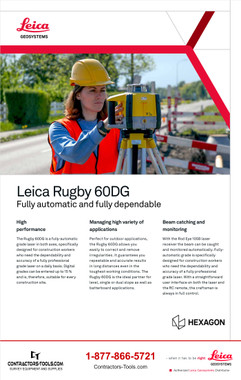
Type your grade in on both axes — and let the laser hold it.
The Leica Rugby 60DG sets X and Y digitally, catches an existing grade on its own, and holds the plane across 3,000 ft while you stay at the work.
LEICA PKG6020269dual axis
Dial a number into the Rugby 60DG and it does the rest. No tilting the head by eye, no walking a rod back and forth to prove the slope — you enter the percentage you need on X, the percentage you need on Y, and the laser levels itself to that plane and keeps it there. Horizontal, single slope, dual slope and batterboard work all come off the same instrument, and it lays down for vertical alignment when the job turns sideways.
This is the laser Leica built for crews who set grade every day and cannot afford to re-shoot it.

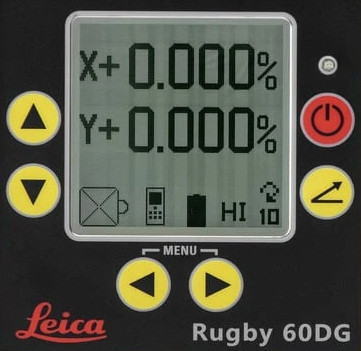
Two numbers. That is the whole job.
Enter the fall you need on X, enter the fall you need on Y, and the Rugby 60DG levels itself to that plane and holds it. The RC60 remote shows the same screen from a thousand feet away, so the grade is never something you have to walk back and check.
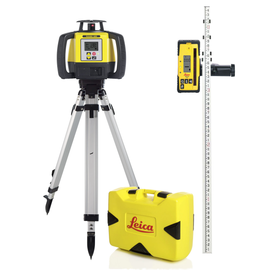
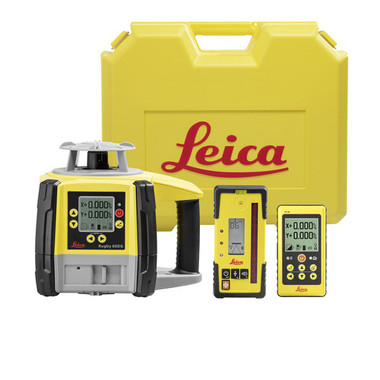
Leica Rugby 60DG Kit — Package 6020269
A complete, ready-to-work dual grade system, customized and shipped by Contractors-Tools.com. Laser, digital receiver, remote and case — nothing else to buy to set grade on day one.
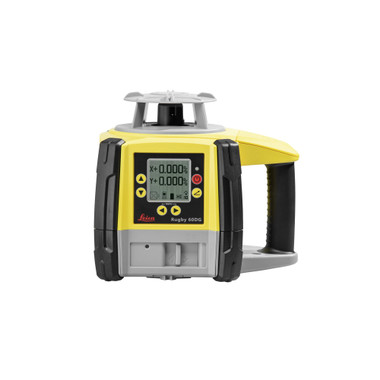
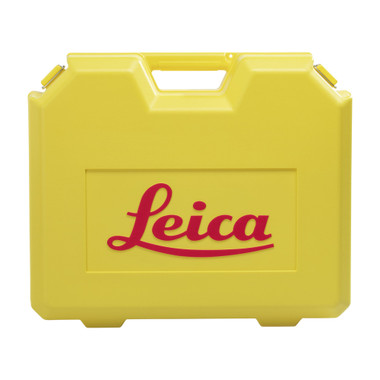
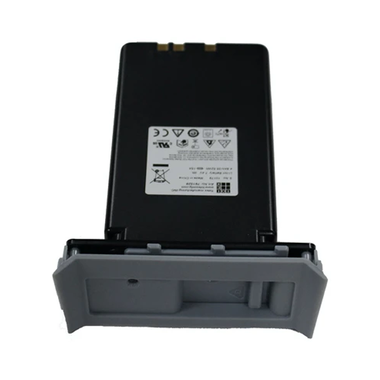
Three things a fully automatic dual grade laser does that a manual one cannot
You enter the number
Punch the grade into the keypad or the RC60 and the Rugby 60DG levels itself to that plane. X and Y are separate figures, entered to three decimal places. There is no tilting the head and checking it with a rod, and no arithmetic on the tailgate.
It finds an existing grade for you
Beam catching: put the Rod Eye 105B where the grade needs to land, and the laser hunts the beam onto the receiver, shows you the grade it found, and then holds it. You match an existing slope without ever calculating it.
It holds the plane after you walk away
Self-levelling runs continuously within ±5°, and the height alert catches a tripod that has been bumped or has settled. At 900 rpm the beam is steadier for a machine-mounted or long-range receiver than a 600 rpm head.
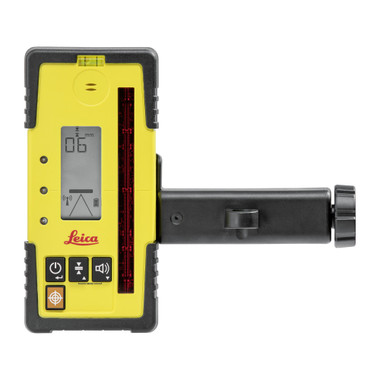
Leica Rod Eye 105B — the half of this kit that does the catching
The Rod Eye 105B is not a passive target. It is the component that makes the Rugby 60DG's headline features work: beam catching and beam lock are receiver-driven, and without the 105B the laser is a conventional dual grade instrument.
It reads out in millimetres on an LCD you can see from the rod, shows a five-channel arrow display for above, below and on-grade, and carries a bubble vial so you know the rod is plumb when you take the shot. Front and rear displays mean you can read it from either side of the rod.
- 105 mm (4 in) extended detection window — a wide capture band, so you spend less time hunting for the beam on a tall rod
- 90 mm (3.5 in) numeric readout — the exact distance off grade in millimetres, not just an arrow
- 900 m / 3,000 ft working diameter — matched to the laser, so the kit has one range, not two
- Two accuracy bandwidths — Fine ±1 mm for finish grade, Coarse ±3 mm for rough cut and fill
- High / Low / Off audio — audible on-grade tone you can turn down in a quiet zone or off entirely
- Beam catch button — the orange key that tells the laser to come find this receiver
- Rod bracket included — clamps to a grade rod straight out of the box
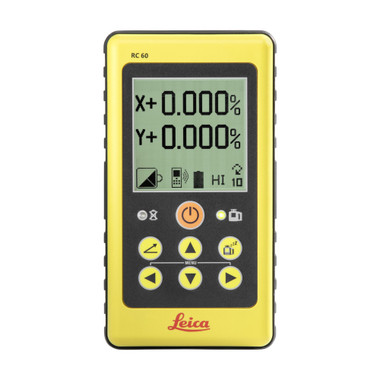
Leica RC60 — the same screen, 1,000 ft away
The RC60 mirrors the laser's own display. The same X+ and Y+ grade percentages, the same menu, the same keys — so there is nothing new to learn and no guessing about what the instrument is doing from across the site.
- 1,000 ft (300 m) operating radius — change grade from where the work is, not from the tripod
- Live X and Y readout — confirm the plane without walking back
- Grade, menu and standby keys — full control of slope entry and alignment
- 70 hours on two AA cells — batteries you can buy anywhere
If you work alone, this is the part of the kit that pays for itself first. Every grade change on a laser without a remote is a walk to the tripod and a walk back.
Every piece in the kit
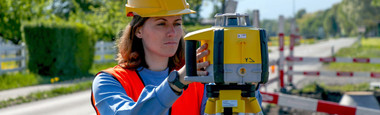
Straightforward enough to hand to anyone on the crew
A fully automatic laser should not need a specialist to run it. Set the Rugby 60DG on the tripod, switch it on, and it levels itself. Everything after that happens on one screen with six keys — and the RC60 remote shows the same screen, so whoever is holding it sees exactly what the laser sees.
Specifications
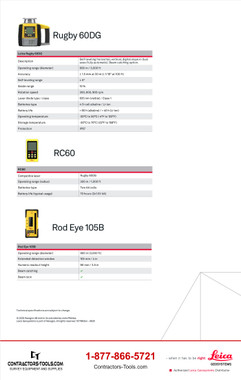
| Function | Self-levelling horizontal, vertical and digital slope in dual axes — fully automatic. Beam catching option. |
| Operating range (diameter) | 900 m / 3,000 ft |
| Accuracy | ±1.5 mm at 30 m (±1/16" at 100 ft) |
| Self-levelling range | ±5° |
| Grade range | 15 % |
| Rotation speed | 300, 600, 900 rpm |
| Laser diode / class | 635 nm visible / Class 1 |
| Battery type | Four D-cell alkaline, or lithium-ion pack |
| Battery life | Over 60 h alkaline / over 40 h lithium-ion |
| Operating temperature | −20 °C to 50 °C (−4 °F to 122 °F) |
| Storage temperature | −30 °C to 70 °C (−22 °F to 158 °F) |
| Protection | IP67 |
| Operating range (diameter) | 900 m / 3,000 ft |
| Extended detection window | 105 mm / 4 in |
| Numeric readout height | 90 mm / 3.5 in |
| Beam catching | Yes |
| Beam lock | Yes |
| Compatible laser | Leica Rugby 60DG |
| Operating range (radius) | 300 m / 1,000 ft |
| Battery type | Two AA cells |
| Battery life (typical) | 70 hours |
Leica Rugby 60DG vs. Leica Rugby 680
Both are dual grade Leica Rugby lasers, and they are genuinely different instruments. The 680 is semi-automatic; the 60DG is fully automatic. Here is every difference that shows up in the field.
| Rugby 680 | Rugby 60DG | |
|---|---|---|
| Self-levelling | Semi-automatic | Fully automatic, both axes |
| Maximum grade | 8 % | 15 % |
| Rotation speed | 600 rpm only | 300 / 600 / 900 rpm |
| Orientation | Upright only | Upright or laydown for vertical |
| Remote control | Not remote capable | RC60 remote, 1,000 ft |
| Beam catch & beam lock | Not available | Both, via the Rod Eye 105B |
| Accuracy | ±1/16" at 100 ft | ±1/16" at 100 ft |
| Protection | IP67 | IP67 |
Shopping the Rugby 680 instead? See the Rugby 680 with Rod Eye 160 receiver and the Rugby 680 K1 package with tripod and tenths rod.
Leica Rugby 60DG — Questions & Answers
Can I type in a grade like 5 %, or do I have to tilt the laser by eye?
What is the difference between this and the Leica Rugby 680?
What does “beam catching” actually do?
Can I run grade on both axes at the same time?
Rechargeable or alkaline — what happens if I forget to charge it?
How far will it reach?
Can I use it vertically?
What is the head speed for, and why three of them?
Is this the same laser as the GeoMax Zone60 DG?
Who do I call if I am not sure this is the right laser?
Pair it up
A dual grade laser is only as steady as what it stands on. Aluminum, composite and wood/fiberglass heavy duty tripods for daily grade work.
Shop heavy duty tripods →Crank the instrument up without breaking the setup. The right choice when the laser has to clear forms, spoil or traffic.
Shop elevator tripods →Rigid and true for repeat shots on the same grade. Available in tenths and in inches.
Shop aluminum grade rods →Non-conductive and lighter to carry all day. The safer rod anywhere near overhead power.
Shop fiberglass grade rods →Downloads
Leica's own published specification for the Rugby 60DG, hosted here so the link does not rot.