
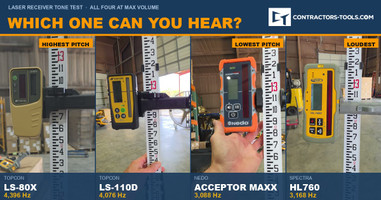
Which Laser Receiver Can You Actually Hear? Four Receivers Tone-Tested on Video
Posted by Contractors-Tools.com on 17th Sep 2026
Which Laser Receiver Can You Actually Hear?
Four Receivers Tone-Tested Side by Side on Video
A customer called us, ordered a Topcon LS-80X, and when it arrived he could not hear the tone well enough on his job site. He left us an unhappy review, and he was right to. Our page said the receiver had loud tones.
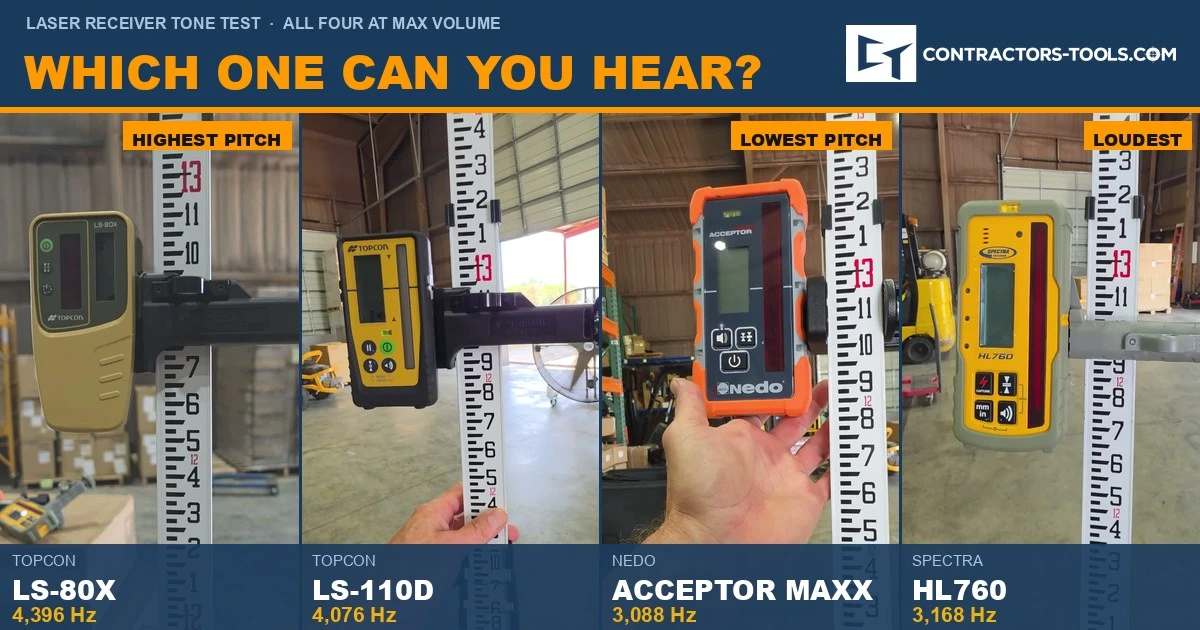
So we put four receivers on a grade rod, set every one of them to maximum volume, recorded them one after another, and then measured the actual pitch of each tone from the audio. What we found says the customer was not being fussy — and it is not only about volume.
Specs cannot tell you what you will be able to hear. Play both videos below with the sound up, listen to each receiver, and pick the one you can hear. That is the whole point of this post.
Video 1 — Topcon LS-80X vs Topcon LS-110D vs Nedo ACCEPTOR MAXX
Three receivers, all at max volume. Chapters are in the video description.
What you are hearing in Video 1
Topcon's base-model receiver. A 2 in. (50 mm) capture window, LCD on front and back, arrows only — no numeric readout of how far off grade you are. The speaker fires from the rear of the unit, so we demonstrated it from behind. Topcon publishes the volume only as “Loud / Low / Off”, with no decibel figure.
A real step up. 3.5 in. (90 mm) upper capture window plus a 3.1 in. (80 mm) lower window, LCD front and back, and a digital readout in millimetres telling you exactly how far off grade you are instead of just high, low or on. Speaker is on the back. Noticeably louder than the LS-80X in our test, and lower pitched — but still up in the 4 kHz range.
A premium German-built receiver with an extra-large 5 in. (120 mm) detector field, illuminated digital displays on front and back, four accuracy settings, IP67 and around 60 hours on two AA cells. It also has LED lights on the front — yellow for low, green for on grade, red for high — so you can read grade without looking at the numbers.
Video 2 — The Spectra HL760, the loudest of the four
Spectra's flagship laserometer, and the one receiver here whose maker will put a number on the volume: Loud 110 dBA, Medium 95 dBA, Low 65 dBA, straight out of the HL760 user guide. It has the largest capture window of the four at 5 in. (127 mm), rubber armour around the sides, IP67, a 10 ft drop rating, a digital readout front and back, a built-in two-way radio, and a premium bracket with a bubble vial so you can keep the rod plumb. Three-year warranty.
Most importantly for this test: the speaker is on the FRONT of the unit, facing the operator. The other three fire their tone away from you.
Spectra HL760 Laser Receiver with rod bracket →
Spectra HL760U — same receiver, red and green beam compatible →
The measured numbers
We measured the on-grade tone of each receiver from the audio of the videos above, every unit at maximum volume. Nobody else in this industry publishes this comparison, because three of the four manufacturers do not publish a decibel rating at all.
| Receiver | Part number | Measured pitch | Loudness rank | Published dB |
|---|---|---|---|---|
| Spectra HL760 | HL760 | 3,168 Hz | 1st — loudest | 110 / 95 / 65 dBA |
| Topcon LS-110D | 1091205-01 | 4,076 Hz | 2nd | not published |
| Topcon LS-80X | 1046259-01-Kit | 4,396 Hz — highest | 3rd | not published |
| Nedo ACCEPTOR MAXX | 430339-185 | 3,088 Hz — lowest | 4th | not published |
Pitch measured by frequency analysis of the on-grade tone in our own recordings. Loudness rank is relative within these recordings — a phone microphone compresses loud sounds, so we publish the ranking and the manufacturer's own figure rather than inventing decibel numbers of our own. Pitch is unaffected by recording gain.
Everybody hears differently — and that is the real answer
Audible tones sound different from person to person. Some contractors hear high-pitched tones better. Others hear lower-pitched tones better. It is not a matter of opinion or of paying attention — it is how ears work, and it changes over a career spent around engines, compressors, saws and hammer drills.
That is why the same receiver can be “plenty loud” to one man and hard to hear for the man standing next to him, and neither of them is wrong.
The measurement that matters most here is the one nobody quotes: the Topcon LS-80X is pitched about 1,200 Hz higher than the Spectra HL760. High-frequency hearing is the first thing most people lose with age. A 4,400 Hz beep that a 25-year-old apprentice picks up instantly can be genuinely faint to a 55-year-old who has been on job sites since he was eighteen. So when our customer said he could not hear his LS-80X, he was not complaining about nothing. He had the highest-pitched and one of the quietest receivers of the four.
If anyone on your crew has trouble hearing a receiver, you want a lower-pitched tone, a louder tone, and a speaker that faces you. The Spectra HL760 is the only one of these four that gives you all three. If the budget will not stretch, the Nedo ACCEPTOR MAXX has the lowest pitch of the group. And if you are buying for a young crew on quiet interior work, the LS-80X is a perfectly good receiver at a much lower price — just go in knowing what its tone sounds like, which is exactly what the video above is for.
Capture height, side by side
While we had all four on the rod, the other number worth comparing is the capture window — how much vertical beam the receiver can see. A taller window means you catch the beam sooner and hold it on a rod that is not perfectly still.
- Spectra HL760 — 5 in. (127 mm), the largest here
- Nedo ACCEPTOR MAXX — 5 in. (120 mm) detector field
- Topcon LS-110D — 3.5 in. (90 mm) upper, plus a 3.1 in. (80 mm) lower window
- Topcon LS-80X — 2 in. (50 mm)
Call us before you order
This is the kind of thing a spec sheet will never settle for you. If you or anyone on your crew has struggled to hear a receiver on a loud site, tell us that on the phone and we will tell you honestly which unit to buy — even when that means the cheaper one. We would rather sell you the right receiver once than the wrong one twice.