
When You Need an Infrared Rotary Laser | Uses and Rules
Posted by Contractors-Tools.com | 1-877-866-5721 on 23rd Oct 2026
When You Need an Infrared Rotary Laser
Uses, Benefits, Safety and What the Rules Really Say
- An infrared rotary laser sets the same level and grade reference as a red laser, with a beam you cannot see.
- Some railroads, mines and facilities restrict visible beams. That rule comes from the site or contract, not from a general U.S. regulation.
- The Spectra Precision GL622IR and GL722-IR are Class 1 infrared grade lasers. Class 1 still calls for normal laser safety practice.
- You always need a compatible receiver to find the beam. Use the one supplied with the package.
- Infrared does not add accuracy or range by itself. You choose it for the site rules.
An infrared rotary laser does everything a red-beam grade laser does: it sets a rotating reference plane for leveling, slope and grade. The difference is the beam. It is invisible, so a compatible electronic receiver detects it and shows whether you are above grade, below grade or on grade. That one difference is why these lasers exist, and why contractors who work around live track and restricted sites buy them.
What is an infrared rotary laser?
An infrared rotary laser is a leveling and grading instrument that emits laser radiation outside the range of light you can see. The transmitter spins a continuous 360-degree reference plane. On a dual-slope model you can also dial in a grade on the X or Y axis, so a contractor setting a 2% drainage slope enters it in the laser and uses the receiver on a rod to hold that slope across the site.
The measuring process is the same as with a conventional rotary laser. The only difference is that the beam does not paint a visible red or green line.
Why choose an infrared laser?
No visible beam to distract anyone
An infrared beam does not put a bright red or green light in front of workers, equipment operators or people doing sensitive work. Where visible-light interference is a concern, that matters.
It fits restricted-beam worksites
Some railroad, mining and industrial worksites restrict visible laser equipment. Where a project specification prohibits visible beams but permits infrared, an approved infrared rotary laser lets you control grade without breaking the rule. Always confirm the equipment requirements with the facility or project safety authority.
Class 1 on select models
The Spectra Precision GL622IR and GL722-IR are classified by the manufacturer as Class 1 laser products, the lowest-hazard classification under the applicable conditions. That counts when equipment is used around people and machinery. It does not replace normal laser safety practice: invisible radiation is not automatically harmless.
Real grade control
A professional infrared rotary laser gives you the same dependable reference plane for setting grades, checking elevations and controlling machines. Depending on the model that can include automatic self-leveling, electronic dual-slope adjustment, automatic axis alignment, grade matching and a radio remote.
Who needs one: required versus preferred
Railroad construction and maintenance
This is the best-documented use. On some active railway lines, visible red laser beams are not permitted, and an infrared grade laser gives you an alternative that does not add a visible red light to the work environment. Typical jobs:
- Trackbed preparation and grading
- Ballast and subgrade elevation control
- Rail corridor drainage installation
- Railway crossings and access road construction
- Railroad yard construction and improvements
- Embankment grading and slope preparation
- Trackside utility and infrastructure installation
Requirement status: infrared equipment may be required by the railroad operator, the project specification or the worksite safety rules. There is no blanket rule that every U.S. railroad project must use infrared rotary lasers.
Mining and specialized excavation
Some mining operations may require equipment that avoids visible laser emissions, especially where visual distractions or site safety restrictions have to be controlled. An infrared rotary laser gives an elevation and grade reference with no visible beam in the work area. Potential uses include mine access roads, excavation grades, pit drainage, haul-road construction and site preparation.
Requirement status: the mine operator's rules and the applicable mining equipment approvals decide. A Class 1 infrared laser is not automatically approved for hazardous or potentially explosive underground atmospheres.
Restricted industrial facilities
Some facilities and contracts set their own visible-light or laser rules. Examples include warehouse floor preparation, industrial foundations, equipment pads and large concrete work. Confirm the facility rules first.
Where infrared is a preference, not a requirement
- Airports and airfields: runway, taxiway and apron grading and drainage. An invisible beam may avoid visible glare, but it is not exempt from aviation safety rules. The airport authority approves equipment, and a beam that could enter navigable airspace has to be evaluated under FAA procedures.
- Highway and heavy civil: subgrade, roadbed, drainage and paving. When crews already depend on receivers, an invisible beam gives the same reference without a visible line.
- Heavy earthmoving: dozers, excavators and motor graders with a receiver approved for the laser.
- Municipal water, sewer and storm drainage: grade for over-the-top pipe installation and excavation control. It is not a substitute for a dedicated pipe laser when the job needs an internal pipe alignment reference.
- Agriculture, land development and sports fields: land leveling, irrigation and drainage, field grading and parking areas.
Infrared or red beam?
| Infrared beam | Red beam | |
|---|---|---|
| Beam visible to workers | No | Yes, under suitable conditions |
| Electronic receiver | Always | Usually for outdoor grading |
| Work near visible-light restrictions | Potentially advantageous | May be prohibited |
| Horizontal leveling | Yes | Yes |
| Electronic slope control | Model dependent | Model dependent |
| Class 1 available | Yes, select models | Depends on the model |
| Accuracy | Set by the instrument | Set by the instrument |
| Typical use | Restricted or specialized worksite | General construction |
Infrared does not automatically give more accuracy, range or reliability than a visible-beam laser. Those depend on the instrument, the receiver and the conditions.
What the regulations actually say
We read the rules so you do not have to. None of them says every railroad, mine or construction site must use infrared. What can require it is the operator or the contract.
| Authority | What it covers | Requires infrared? |
|---|---|---|
| OSHA 29 CFR 1926.54 | Construction laser operation, trained operators, exposure and safety controls | No |
| FDA 21 CFR 1040.10 and 1040.11 | Laser product classification and emission limits | No |
| FRA 49 CFR Part 214 | Railroad worker protection and on-track safety | No general rule |
| MSHA and 30 CFR | Mining safety and electrical equipment approvals | No general rule |
| FAA outdoor laser procedures | Beams that could affect aircraft or navigable airspace | No |
| ANSI Z136.1 and IEC 60825-1 | Laser safety practice and classification | No |
| Railroad or mine operator specifications | Site-specific permitted equipment and beam restrictions | Can require infrared |
OSHA. The construction laser rule, 29 CFR 1926.54, calls for qualified and trained laser operators, warning placards, controls to prevent unnecessary emissions and no beams directed at employees. A 1993 OSHA interpretation says Class I lasers are covered by the rule and most violations involving them are treated as de minimis, except exposure-limit violations. That does not mean a Class 1 laser is exempt from workplace safety duties.
FDA. Surveying, leveling and alignment lasers are classified under 21 CFR 1040.10 and 1040.11. Classification is model-specific; it does not apply automatically to every infrared transmitter. The eye's normal blink reaction to bright visible light cannot be relied on for invisible radiation.
Railroads. 49 CFR Part 214 requires worker protection programs. It does not contain a nationwide requirement for infrared lasers. Spectra's literature does list the GL722-IR for rail work where red beams are not allowed on live track, so the use is real, but the requirement is the railroad's.
Mining. Approval of electrical equipment for hazardous underground atmospheres is separate from a laser's optical safety class. A Class 1 laser is not automatically intrinsically safe or approved. The mine operator must confirm the whole product for its location.
Airports. The FAA outdoor laser procedures separate visible glare from radiation exposure. A beam fully contained in a worksite is treated differently from one directed into airspace.
General guidance, not a legal compliance certification. Follow applicable regulations, manufacturer instructions, railroad or facility operating rules and your contract.
Infrared lasers we sell
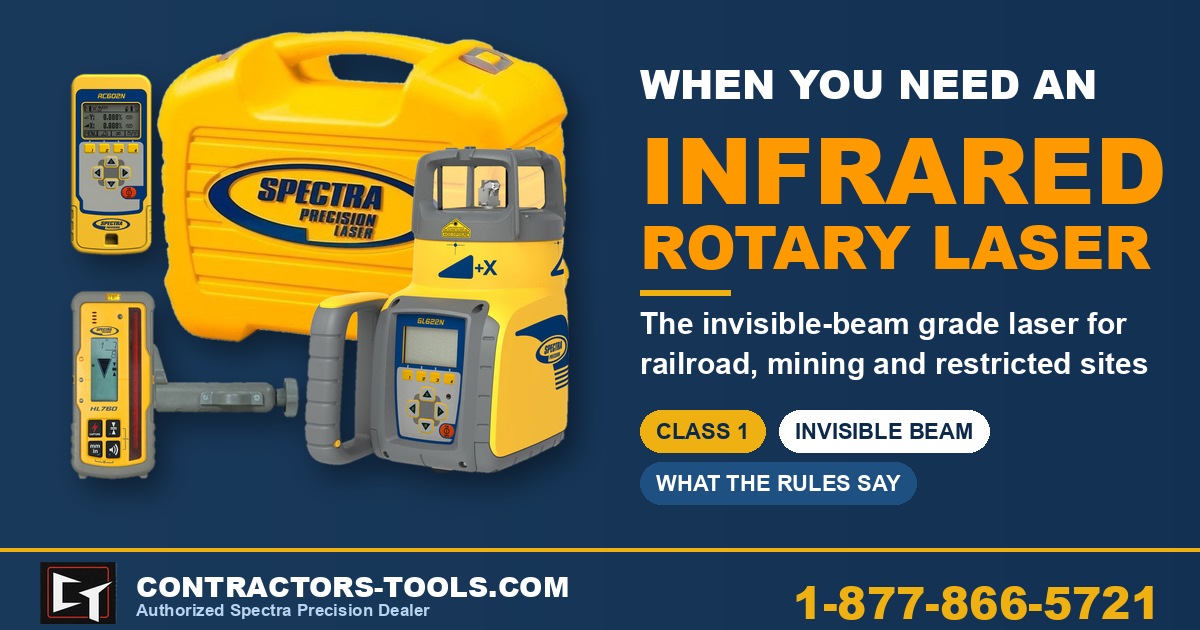
Class 1 invisible beam, plus or minus 25% grade on both axes (one at a time), about 2,600 ft working diameter with the receiver, the HL760 receiver with C70 rod clamp, RC602N remote, NiMH battery pack, charger and case. A grade and level laser: it is not used for vertical alignment or 90-degree layout. See the GL622IR
Infrared model listed for rail work where red beams are not allowed on live track. Longer range, up to 3,000 ft diameter, X axis plus or minus 10% and Y axis -0.5 to +25%, RC703 long-range radio remote, CR600 rod or machine receiver with clamp and magnetic mount. See the GL722-IR
If a visible beam is allowed on your site, the red-beam Spectra Precision GL622N is the same dual grade laser and also does vertical and 90-degree work. We will tell you honestly which one fits.
How to use an infrared rotary laser
- Verify the site requirements. Confirm the laser, its classification and its accessories are permitted under the project and facility safety plan.
- Set up the transmitter. Put it on a stable tripod or an approved mount where it gives a steady reference plane.
- Establish the reference elevation. Check calibration and set a known benchmark before you start measuring.
- Program the grade. For a slope, enter the percentage on the X or Y axis at the laser or on the remote.
- Read elevations with the receiver. Mount it on a rod or an approved machine bracket and follow its above, below and on-grade indications.
- Verify as you go. Recheck known references after any bump, move or change in the setup.
- Shut the transmitter down when the work is done, following the manufacturer's instructions and your safety procedures.
Frequently asked questions
Can you see an infrared rotary laser beam?
No. The infrared beam is outside the range of light the human eye can see. A compatible electronic receiver detects the reference plane and tells you above, below or on grade.
Are infrared rotary lasers required on railroad projects?
Some railroad projects prohibit visible red laser beams and require or permit an infrared alternative. The requirement comes from the railroad operator, the project specification or the worksite safety procedures, not from a universal U.S. rule. Confirm yours before you order.
Does OSHA require infrared rotary lasers?
No. OSHA regulates laser safety on construction sites (29 CFR 1926.54) but does not generally require contractors to choose infrared rather than visible-beam rotary lasers.
Are infrared lasers safer than red lasers?
It depends on the product's certified laser classification, the radiation it emits and how it is used. The Spectra Precision GL622IR and GL722-IR are classified by the manufacturer as Class 1, the lowest-hazard classification, but invisible radiation is never automatically harmless. Follow the manufacturer's safety instructions and your site rules.
Will an infrared rotary laser work with any laser receiver?
No. The receiver has to support the transmitter and its operating characteristics, and not every red-beam receiver can detect an infrared laser. Advanced automatic functions can also require a specific manufacturer-approved receiver. The GL622IR ships with an HL760 that works with it. If you want to use a different receiver, ask us first.
Do infrared lasers work in direct sunlight?
Yes. A compatible infrared rotary laser system works outdoors in daylight using an electronic receiver. You cannot see the beam by eye, and the working range depends on the equipment and the site conditions.
Can an infrared laser be used for machine control?
Yes, when the receiver and machine-control setup are approved for the transmitter you chose. Check compatibility before you buy or install anything.
Is an infrared laser more accurate than a red laser?
No. Infrared does not by itself give more accuracy, range or reliability than a visible-beam laser. Those depend on the instrument, the receiver and the site. You choose infrared because of the site rules, not for the numbers.
Can I use an infrared laser in a mine?
Possibly. Some mines restrict visible beams, but the mine operator's rules and the applicable equipment approvals decide. A Class 1 infrared laser is not automatically approved for hazardous or potentially explosive underground atmospheres.
Can the Spectra GL622IR do vertical alignment?
No. The GL622IR is not used for vertical alignment or 90-degree layout. It is a grade and level laser. For plumb and vertical work, use a red-beam laser such as the GL622N.
Sources and references
- OSHA 29 CFR 1926.54, Nonionizing radiation (construction lasers)
- FDA 21 CFR Part 1040, Radiation-emitting products and the FDA surveying, leveling and alignment laser guidance
- FRA 49 CFR Part 214, Railroad workplace safety and Roadway Worker Protection
- FAA outdoor laser operations
- Spectra Precision GL622IR and GL722-IR product literature; ANSI Z136.1 and IEC 60825-1 for laser classification
Related reading
- Which laser receiver can you actually hear? Four receivers tone-tested on video
- Spectra Precision GL622IR infrared dual grade laser
- Spectra Precision GL722-IR with RC703 remote and CR600 receiver
- Spectra Precision GL622N red-beam dual grade laser
- Spectra HL760 digital readout laser receiver
Call us before you order
Tell us the application, the distance, the grade and the site rules, and we will tell you which infrared laser fits, or whether a red-beam laser is allowed and cheaper. We would rather sell you the right laser once than the wrong one twice.