


Self-Leveling Rotary Laser
One Person. On Grade. All Day.
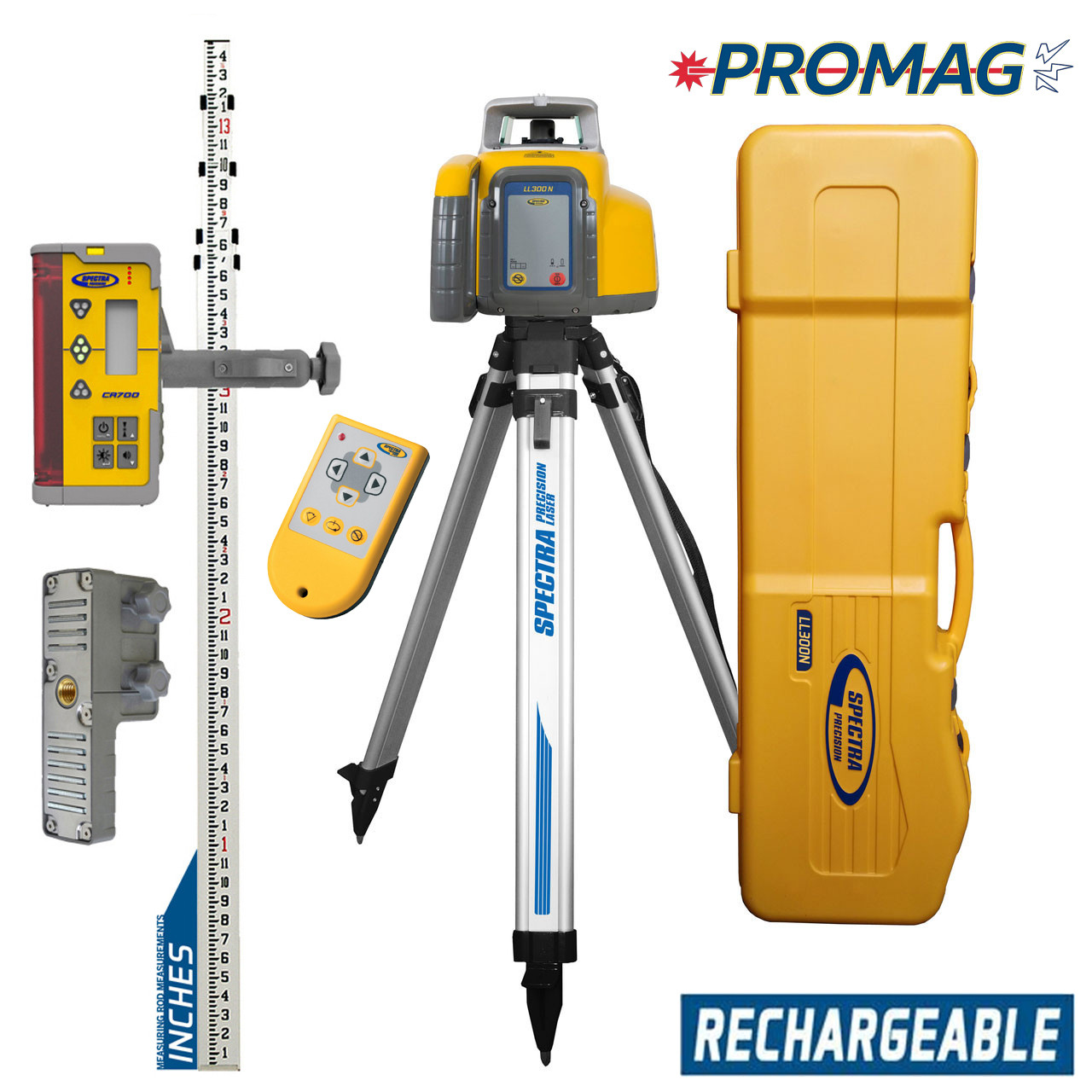
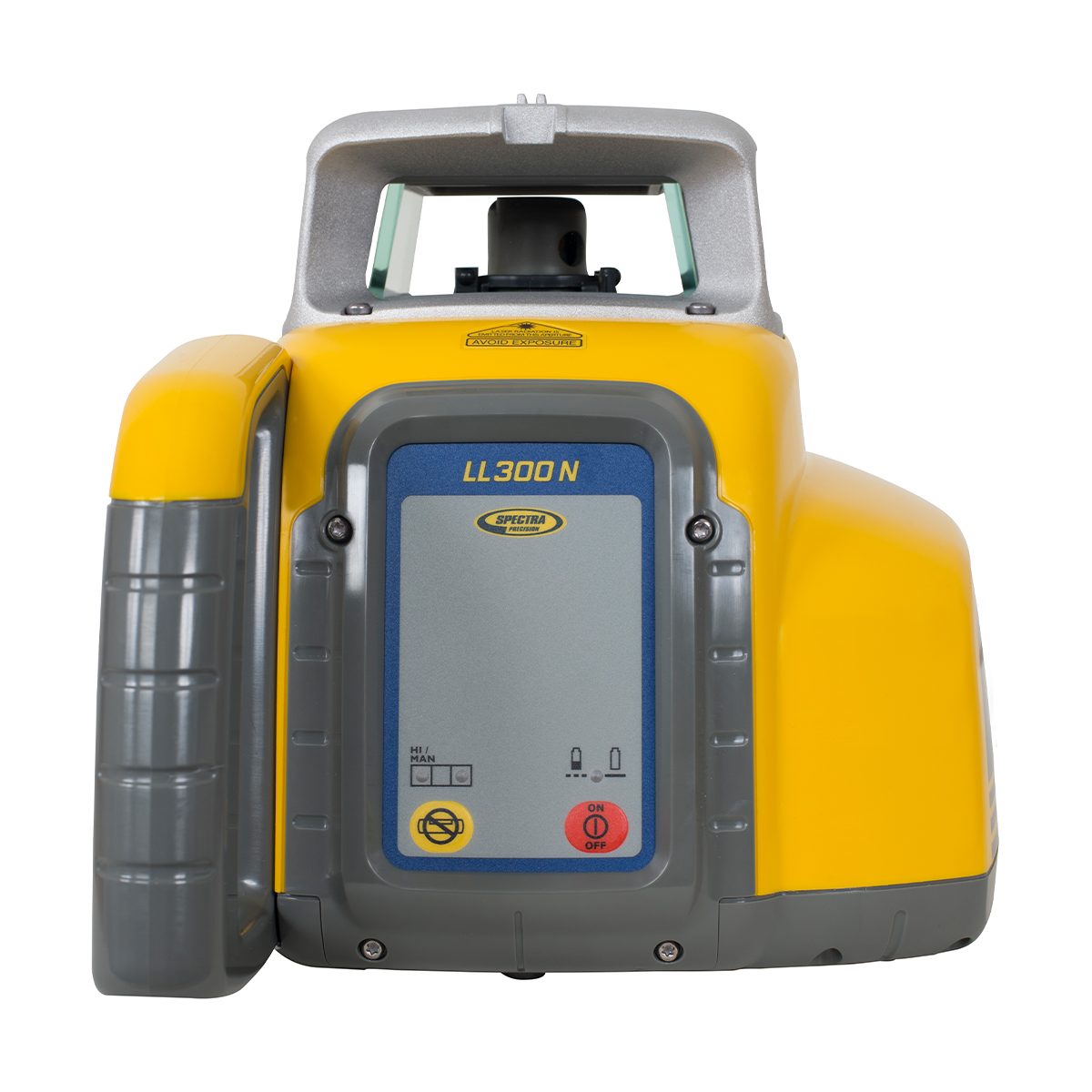
Grade in feet and inches and the arithmetic stops fighting you. Cut and fill come straight off the plans, the numbers add the way a calculator expects, and nobody is converting sixteenths in their head at the back of a trench. The Spectra Precision LL300N-CR72 is built around that: a self-leveling rotary laser, the CR700 combination receiver, the GR152 15-foot rod graduated in inches, the Q104025 tripod and the hard case that carries the lot.
Set the laser on its tripod, give it about half a minute to find level, and it holds a plane you can work off all day — accurate to 3/32-inch at 100 feet across a 1,650-foot spread, and the CR700 in this kit reads it out to 1,500 feet. Footings, forms, pads, sub-grade, drainage falls, pond bottoms, driveways: if it needs an elevation held over distance, this is the tool, and one person runs it.
Spectra did not build it delicately. A “hard hat” rotor guard covers the spinning head, it takes a 3-foot drop onto concrete or a 5-foot fall off a knocked tripod. Spectra are clear about what to do next, and so are we: after any drop, re-check the leveling accuracy before you carry on — the procedure is in the user guide, two walls 65 ft apart and four readings. An IP66 seal means rain, dust and washdown are non-events. Four D-cells run it 90 hours — a fortnight of real days. Five year warranty on the laser, three on the receiver.
Slope is available, but it runs off the RC601 remote, which is sold separately. There are no slope controls on the laser itself, and manual slope means you tilt the beam and check it with the receiver — there is no field to type a grade percentage into. If you need an exact number dialled in, that is an automatic slope laser, and we would rather tell you that now.
It all travels in the 5289-0027 All in One system case, cut with a pocket for each piece, so the laser, the CR700, the rod sections and the tripod legs each have a home.
Grab your case and know you have everything, ready to go to work.

Two Things People Get Wrong.
The LL300N-CR72 ships the GR152 — 15 ft, five section, graduated in INCHES. If you read grade in tenths of a foot, you want the LL300N-CR71 — identical kit, tenths rod. Getting this wrong is the most common reason one of these comes back.
Out of the case this is a self-leveling horizontal laser. There are no slope controls on the face of the laser at all — the arrow keys that tilt the beam exist only on the remote. Add the RC601 and you get manual slope on both axes. And manual slope is not the same as typing in a grade.
What You Receive.
LL300N Laser
Automatic self-leveling rotary laser. 600 rpm, ±5° self-leveling, IP66, five year warranty.
CR700 Receiver
Combination machine and rod receiver. 5 in capture, 4 in digital readout, six accuracies down to 1/32 in, two-way radio, IP67, 10 ft drop rating.
C70 Rod Clamp + C71 Magnet Clamp
Both mounts for the CR700 ship in the box — the magnet clamp for the machine, the rod clamp for the GR152. Nothing else to buy to run it either way.
GR152 Grade Rod — INCHES
15 ft, five section aluminum, graduated in inches. The reason this kit is the “-2”.
Q104025 Tripod
Medium duty aluminum, 5/8 x 11 threaded post. The only tripod that fits inside the case — which is why it ships with it.
5289-0027 All in One System Case
Purpose-built hard case with a cut pocket for every component.
Grab your case and know you have everything, ready to go to work.
Four D-Cell Alkaline Batteries
90 hours of rotation, and spares are in every hardware store. Want to stop buying them? The Q104234 rechargeable pack and charger drops straight in — about 45 hours a charge.
The Case Is Half the Kit.

This kit ships the 5289-0027 — the LARGE All in One system case, not a small case and not a soft bag. It is cut with a dedicated pocket for every piece: the laser, the CR700, the rod sections and the tripod legs.
Grab your case and know you have everything, ready to go to work.
Where This Laser Earns Its Keep.
Full Specification.
| Specification | LL300N |
|---|---|
► ACCURACY & RANGE | |
| Leveling accuracy | ±3/32 inch at 100 ft (±2.2 mm at 30 m) — ±15 arc seconds |
| Working diameter | The laser transmits to 1,650 ft (500 m). The CR700 in this kit has a working radius of 1,500 ft (460 m) — a more sensitive receiver reaches further. |
| Self-leveling range | ±5° electronic servo self-leveling |
| Leveling time | approx. 30 seconds |
► LASER & ROTATION | |
| Rotation speed | 600 rpm |
| Laser type / class | 635 nm, Class 2, < 3.4 mW |
| Beam diameter | approx. 8 mm at the laser |
► POWER | |
| Power source | 4 x D-cell alkaline (included) or optional NiMH rechargeable batteries |
| Battery life | 90 hours alkaline / 45 hours NiMH |
► BUILT TO BE DROPPED | |
| Environmental rating | IP66 — dust tight, protected against powerful water jets |
| Drop rating | 3 ft onto concrete · 5 ft tripod tip-over |
| Operating temperature | -4 °F to 122 °F (-20 °C to 50 °C) |
► PHYSICAL | |
| Tripod mount | 5/8 x 11, horizontal and vertical |
| Dimensions | 10.7 x 7.7 x 7.9 in (27.2 x 19.7 x 20.1 cm) |
| Weight | 5.9 lb (2.7 kg) bare — 6.8 lb (3.1 kg) with the four D-cells |
► WARRANTY | |
| Warranty | 5 years laser · 3 years CR700 receiver |

The Receiver Is the Upgrade.
Most laser packages hand you a receiver that does one thing: sit on a rod. An HL450 package is exactly that — a good rod receiver, and it stays on the rod. This kit carries the CR700 multi-use instead, the top receiver Spectra builds for this class of laser, and that is the whole reason to spend the difference: it goes on the machine too, with both mounts in the box.

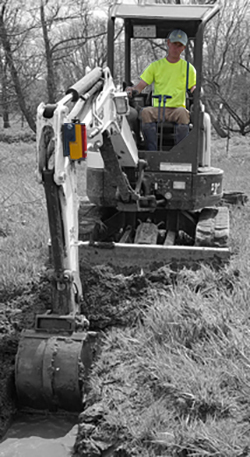
The C71 magnet clamp holds it to the dipper stick of a backhoe, skid steer or mini excavator. Now you are reading cut and fill from the seat instead of climbing down and grabbing a rod every time.

Drop it in the C70 rod clamp and onto the GR152. This is not a stripped-down rod receiver — it is the top of the line, working the way the rest of the family does.
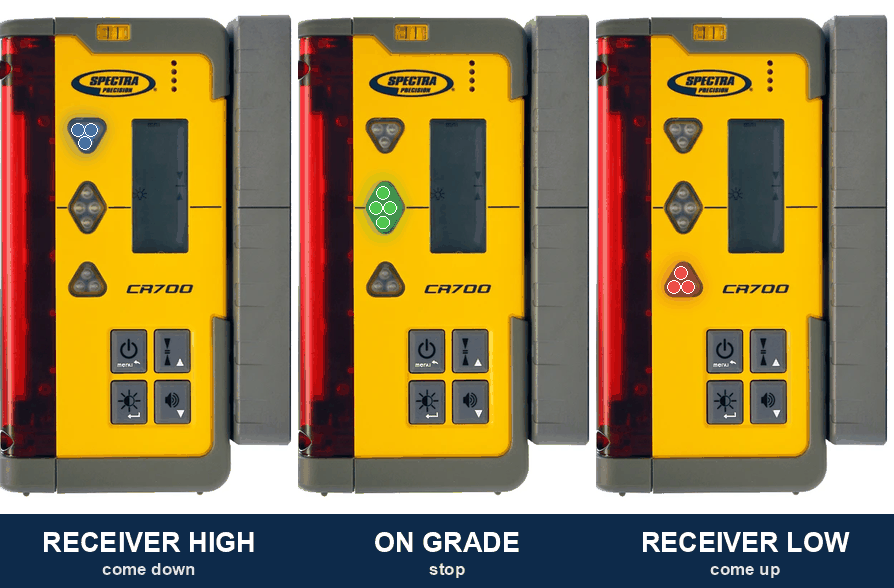
Super-bright LEDs on both faces, so you read them from the cab or down the rod. Three brightness settings, and three beeper volumes — 110, 95 and 65 dBA — so the tone carries on the rod and the arrows carry from the cab.

• 200° reception angle — it picks the laser up without being aimed at it.
• The tone and the number — slow beep high, fast beep low, solid on grade, at up to 110 dBA so you hear it over a running machine — and a 4 in digital readout of exactly how far off grade you are.
• Six accuracies, 1/32 in to 1 in — rough cut in the morning, finish grade after lunch.
• IP67, a 10 ft drop rating and a 3-year warranty.
The CR700 is the receiver contractors ask for once they have used one: it reads grade on the rod like any receiver, and it magnet-mounts to the machine so you can check cut and fill from the seat. One receiver covering both jobs, with both clamps in the box.
Buy it as a standalone and the CR700 runs $559.20 on its own. We put it straight into the kit. Here is how that compares with adding one to the standard LL300N-2 package.
| LL300N-2 package | $1,084.85 |
| plus a CR700 bought separately | $559.20 |
| That route costs | — |
| This kit, CR700 already in it | $1,395.00 |
You keep — and the multi-use receiver is in the case on day one. We put these kits together because the people buying them asked for them — that is the whole reason they exist, and it is why you will not find this one anywhere else.
Every part of this kit is something we sell separately, so the arithmetic is easy to check. These are live prices from their own product pages.
| CR700 combination receiver | $559.20 |
| GR152 15 ft inches grade rod | $85.00 |
| Q104025 aluminum tripod | $125.00 |
| 5289-0027 All in One system case | $123.00 |
| Accessories on their own | — |
| This kit, laser included | $1,395.00 |
The accessories alone account for most of it. What is left buys the LL300N laser itself — for less than the laser-and-case-only LL300N-BCA sells for on its own.
Slope, and What It Actually Means.
The LL300N is slope capable through the RC601 remote — an inexpensive add-on that unlocks manual and single-axis slope whenever you need it. There are no slope controls on the face of the laser: the panel has a power button, a manual button and three indicator lights, and nothing on the housing tilts the beam.
Red LED flashing once a second. Y tilts on the remote’s up/down arrows, X on left/right.
Red and green both flashing. Y tilts from the remote while X keeps self-leveling — ramps and driveways.

Unlocks manual slope on both axes plus Single Slope mode. Infrared — no pairing, no channels. Works to about 100 ft with line of sight.
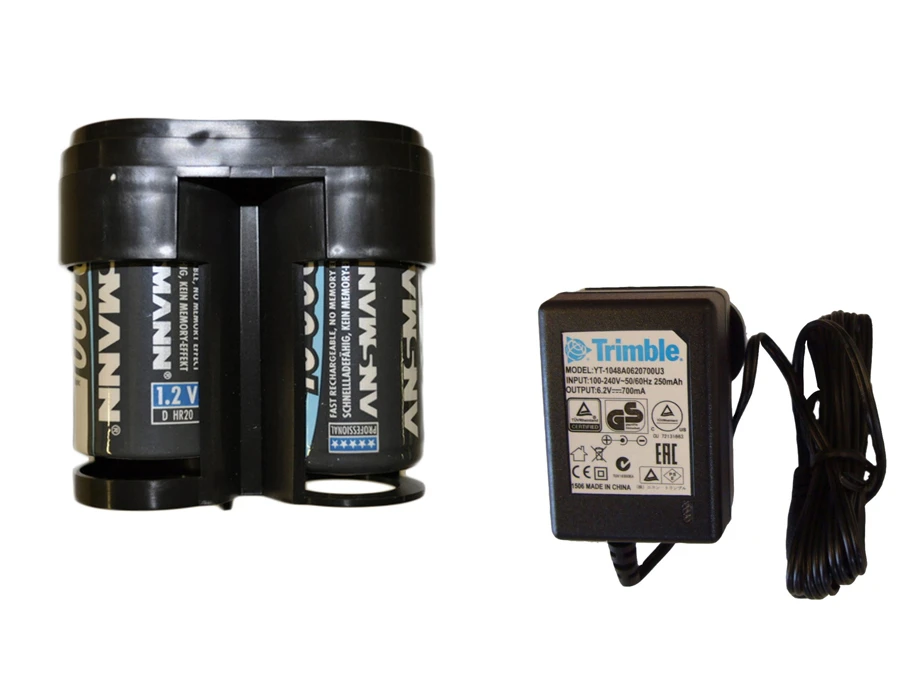
High-capacity 10,000 mAh NiMH D-cells with a 110 V charger. Stop buying D-cells — charge overnight in the truck instead.
Two Upgrades Worth Adding.
Everything you need to shoot grade is in the case. These two are what crews add once the laser has earned its place — both drop straight in, no adapter and no trade-in.
This is what turns the laser into a slope laser. Manual mode and single-axis slope for driveways, ramps and drainage falls — set from up to 100 ft away instead of walking back to the tripod every adjustment. Without it the LL300N is self-leveling only.
NiMH pack and 110 V charger, about 45 hours a charge. If you run this laser weekly it pays for itself in D-cells inside a season, and there is no hunting for batteries on a Saturday morning.
Add both and you have effectively built the LL300N-2-PROMAG — the same kit with the remote and rechargeable pack already in the case, which we sell as one part number if you would rather buy it that way.
Which LL300N Do You Need?
Every kit below uses the same LL300N laser. What changes is the rod scale, the receiver, the tripod and whether a remote or rechargeable batteries are included. They are grouped by rod scale, because that is the choice that actually matters — and the one that causes returns.
| Kit | Receiver | Rod | Also includes | Price |
|---|---|---|---|---|
► LARGE “ALL IN ONE” SYSTEM CASE | ||||
READS IN INCHES | ||||
| LL300N-2 | HL450 BETTER | INCHES | TRIPODSYSTEM CASE | $1,084.85 |
| LL300N-CR72 YOU ARE HERE | CR700 BEST | INCHES | TRIPODSYSTEM CASE | $1,395.00 |
| LL300N-2-PROMAG | CR700 BEST | INCHES | REMOTERECHARGEABLETRIPODSYSTEM CASE | $1,575.00 |
READS IN TENTHS OF A FOOT | ||||
| LL300N-1 | HL450 BETTER | TENTHS | TRIPODSYSTEM CASE | $1,084.00 |
| LL300N-CR71 | CR700 BEST | TENTHS | TRIPODSYSTEM CASE | $1,395.00 |
| LL300N-1-PROMAG | CR700 BEST | TENTHS | REMOTERECHARGEABLETRIPODSYSTEM CASE | $1,595.00 |
METRIC | ||||
| LL300N-3 | HL450 BETTER | Metric | TRIPODSYSTEM CASE | $1,084.00 |
► SMALL CASE | ||||
READS IN INCHES | ||||
| LL300N-82 | HR320 GOOD | INCHES | HD TRIPODSMALL CASE | $985.00 |
| LL300N-X2 | HL450 BETTER | INCHES | HD TRIPODSMALL CASE | $1,095.00 |
| LL300N-X2 PRO | HL450 BETTER | INCHES | REMOTERECHARGEABLEHD TRIPODSMALL CASE | $1,295.00 |
| LL300N-X22 | HL760 BEST | INCHES | HD TRIPODSMALL CASE | $1,295.00 |
| LL300N-X22 PRO | HL760 BEST | INCHES | REMOTERECHARGEABLEHD TRIPODSMALL CASE | $1,445.00 |
READS IN TENTHS OF A FOOT | ||||
| LL300N-81 | HR320 GOOD | TENTHS | HD TRIPODSMALL CASE | $985.00 |
| LL300N-X1 | HL450 BETTER | TENTHS | HD TRIPODSMALL CASE | $1,095.00 |
| LL300N-X1 PRO | HL450 BETTER | TENTHS | REMOTERECHARGEABLEHD TRIPODSMALL CASE | $1,295.00 |
| LL300N-X11 | HL760 BEST | TENTHS | HD TRIPODSMALL CASE | $1,295.00 |
| LL300N-X11 PRO | HL760 BEST | TENTHS | REMOTERECHARGEABLEHD TRIPODSMALL CASE | $1,445.00 |
KITS WITH NO ROD AND TRIPOD | ||||
| LL300N-8 | HR320 GOOD | — | SMALL CASE | $935.00 |
| LL300N | HL450 BETTER | — | SMALL CASE | $964.00 |
| LL300N-4 | HL450 BETTER | — | RECHARGEABLESMALL CASE | $1,045.00 |
| LL300N-PRO | HL450 BETTER | — | REMOTERECHARGEABLESMALL CASE | $1,195.00 |
| LL300N-7 | HL760 BEST | — | SMALL CASE | $1,048.00 |
► LASER AND CASE ONLY — NO ROD, NO TRIPOD | ||||
| LL300N-BCA | — | — | SMALL CASE | $694.40 |
| LL300N-BCC | — | — | RECHARGEABLESMALL CASE | $792.00 |
Not sure? Call 1-877-866-5721. We would rather spend two minutes on the phone than process a return.
See It Work.
 ►► PLAYING
Basic Functions with the RC601 RemoteWalkthrough of the LL300N controls, and what the RC601 adds — manual mode, single slope and the arrow keys.
►► PLAYING
Basic Functions with the RC601 RemoteWalkthrough of the LL300N controls, and what the RC601 adds — manual mode, single slope and the arrow keys.
 ►► PLAYING
Drop Test & Water Resistance DemoThe 3-foot drop onto concrete and the water test — what IP66 and the “hard hat” rotor guard actually mean.
►► PLAYING
Drop Test & Water Resistance DemoThe 3-foot drop onto concrete and the water test — what IP66 and the “hard hat” rotor guard actually mean.
 ►► PLAYING
One-Person Grade CheckingOne receiver that clamps to a grade rod or magnet-mounts to a machine, and takes the rod out of a second person’s hands.
►► PLAYING
One-Person Grade CheckingOne receiver that clamps to a grade rod or magnet-mounts to a machine, and takes the rod out of a second person’s hands.
 ►► PLAYING
Best Way to Get a Good GradeUsing the CR700 to hold accurate grade — deadbands, the digital readout and reading the arrows.
►► PLAYING
Best Way to Get a Good GradeUsing the CR700 to hold accurate grade — deadbands, the digital readout and reading the arrows.
 ►► PLAYING
Toolaholic on the JobsiteAn independent take — Toolaholic running the CR700 in real dirt rather than a showroom.
►► PLAYING
Toolaholic on the JobsiteAn independent take — Toolaholic running the CR700 in real dirt rather than a showroom.
LL300N Questions We Actually Get.
Does the LL300N-CR72 come with a tenths rod or an inches rod?
Is the Spectra LL300N slope capable?
There are no slope controls anywhere on the face of the laser. The panel has two buttons, power and manual, plus three indicator lights. The manual button takes the laser out of automatic self-leveling, but nothing on the housing tilts the beam. The arrow keys that set slope exist only on the RC601.
With the remote you get two modes. In Manual mode both axes tilt — Y on up/down, X on left/right. In Single Slope mode Y slopes from the remote while X keeps self-leveling, which is how ramps and driveways are set.
What you do not get is automatic slope. There is no way to key a grade percentage into an LL300N.
What is Manual mode on the LL300N, and what does it actually do?
Normally the laser is in automatic self-leveling: it finds level on its own, then keeps checking and re-correcting every few seconds so the plane stays level all day. Put it in Manual mode and it stops doing that. It holds whatever attitude you give it, so when you tilt the beam with the remote’s arrow keys, it stays tilted instead of quietly levelling itself back out.
Read the LEDs to know which mode you are in:
• Green flashing — automatic self-leveling. Normal level work.
• Red flashing — Manual mode. Self-leveling is off, both axes tilt from the remote.
• Red and green both flashing — Single Slope mode. The Y-axis tilts from the remote, the X-axis keeps self-leveling.
The thing to watch: in Manual mode the laser will not fix itself. If the tripod gets bumped or settles, the beam moves with it and nothing corrects it back — so re-check your grade against a benchmark before you trust it. That protection is exactly what you gave up to get slope. Press the manual button again to come back to automatic, and the green LED tells you it is watching itself once more.
What do the LL300N’s LED lights mean? (full list)
| LED | State | What it means |
|---|---|---|
| All three, 3 sec | Powering up | Leveling, manual/HI and battery indicators all light for about three seconds at switch-on, then self-leveling begins on its own. |
| Green, 1×/sec | Self-leveling | The laser is finding level. The head will not spin until it gets there. Takes about 30 seconds. |
| Green, solid | Level, first 5 min | It found level. Solid for roughly five minutes after self-leveling completes. |
| Green, every 4 sec | Level, working | Settled and self-checking. This is the normal working state — the occasional blink is the laser telling you it is still level. |
| Green + red together + warning tone | Out of range | You have set it up beyond its ±5° (±8%) self-leveling range. It cannot compensate. Re-level the tripod head and it will pick up. |
| Red, 1×/sec | Manual mode | Self-leveling is OFF. Both axes tilt from the remote’s arrow keys. The laser will not correct itself if it is disturbed. |
| Red + green, 1×/sec | Single Slope mode | Y-axis tilts from the remote, X-axis keeps self-leveling. The setup for ramps and driveways. |
| Red, 2×/sec + tone, beam off | HI alert | Height of instrument changed. Something knocked the setup and the beam moved more than about 30 mm at 10 m. The head stops and the beam shuts off so you cannot shoot off a bumped laser. Power off and on, then re-check your elevation against a benchmark. |
| Battery, slow flash | Low battery | Voltage is dropping. It will shut itself off rather than drift out of tolerance on dying cells. |
The short version: green means the laser is looking after itself, red means it is not, and red flashing twice a second means stop and re-check your grade.
What do the CR700 arrows and beeps mean?
• Slow beep — you are HIGH. Come down.
• Fast beep — you are LOW. Come up.
• Constant tone — you are ON GRADE. Stop.
The CR700 does all three at once. Bright LED arrows show the direction — blue for high, red for low, green when you are on grade — and the LCD prints the exact distance from grade beside them, down to 1/32 inch on the finest of its six settings. You are not hunting for a tone; you are reading a number.
Can I enter a slope percentage such as 5% on the LL300N?
How do I pair the RC601 remote to the LL300N?
How far away will the RC601 remote work?
How far will the Spectra LL300N-CR72 reach?
Does the LL300N-CR72 kit come with rechargeable batteries?
I dropped my LL300N. Is it still accurate?
The check takes about five minutes and needs two walls roughly 65 ft (20 m) apart. Set up near wall A, let it self-level, mark the beam on wall A. Turn the unit 180°, let it level, mark wall B. Move the laser near wall B and repeat both marks. Within working accuracy the difference across that 40 m round trip should be no more than about 4 mm (3/16 inch). Repeat for the other axis. The full procedure with diagrams is in the user guide linked below.
If it is out, stop using it for grade work and call us on 1-877-866-5721.
Can the Spectra LL300N be left out in the rain?
What does the CR700 receiver tell me?
Can the LL300N be used vertically for plumb and wall layout?
My LL300N will not self-level, or it started rotating immediately. What is wrong?
The laser stopped, the beam went off and it beeped. What happened?
The head is spinning but my receiver will not pick up the beam.
My grade reads differently than it did earlier and nothing was moved. Why?
My LL300N will not turn on, or it shuts itself off during the day.
Important: never take the rechargeable pack out of its holder and put alkaline cells in that holder. A mechanical switch is what stops alkalines being charged — defeat it and attempting a charge will severely damage the laser.
Self-leveling is slow, or it never finishes leveling.
Two receivers on the same laser give different readings.
How long is the warranty on the LL300N-CR72?
Reading the Lights.
The LL300N tells you everything through three indicators — a green leveling light, a red manual/HI warning light and a battery light. The dots below blink at the actual rates, so you can match what you are looking at on the jobsite.
| Indicator | State | What it means |
|---|---|---|
| Powering up | All three light for about three seconds at switch-on, then self-leveling starts on its own. | |
| Self-leveling | Finding level. The head will not spin until it gets there — about 30 seconds. | |
| Level — first 5 min | It found level. Solid for roughly five minutes after self-leveling completes. | |
| Level — working | Settled and self-checking. The occasional blink is the laser telling you it is still level. This is what you want to see all day. | |
| Out of range | Set up beyond the ±5° (±8%) self-leveling range, with a warning tone. It cannot compensate — re-level the tripod head and it will pick up. | |
| Manual mode | Self-leveling is OFF. Both axes tilt from the remote’s arrow keys. The laser will not correct itself if it gets disturbed. | |
| Single Slope mode | Y-axis tilts from the remote, X-axis keeps self-leveling. The setup for ramps and driveways. | |
| HI alert — stop | Twice a second, with a tone, and the beam shuts off. Something moved the setup more than about 30 mm at 10 m. Power off and on, then re-check your elevation against a benchmark before you trust another reading. | |
| Low battery | Voltage dropping. It will shut itself off rather than drift out of tolerance on dying cells. |
The short version: green means the laser is looking after itself, red means it is not, and red blinking twice a second means stop and re-check your grade.
Only These Fit the Case.
Rods and tripods take the worst of it. The 5289-0027 system case is cut to fit specific ones — replace with the wrong part and it will not go back in the case.
This kit reads in inches — your replacement is the GR152 or the SitePRO 11-815-C. The tenths rods fit the case just as well, but they change how you read grade.
Where the LL300N Sits.
Spectra's own comparison of the horizontal laser range. Every model name links to that laser on our site. The LL300N is the workhorse of the line — if you need longer range or vertical work, the columns to the right are where you go.
► LASER LEVELS |
► HORIZONTAL & VERTICAL | ||||
| LL300N THIS LASER | LL1505C | LL500 | HV1305C | HV1305GC | |
|---|---|---|---|---|---|
| Accuracy | 3/32 inch @ 100 ft 2.2 mm @ 30 m (15 arc seconds) | 1/16 inch @ 100 ft 1.5 mm @ 30 m (10 arc seconds) | 1/16 inch @ 100 ft 1.5 mm @ 30 m (10 arc seconds) | 1/16 inch @ 100 ft 1.5 mm @ 30 m (10 arc seconds) | 1/16 inch @ 100 ft 1.5 mm @ 30 m (10 arc seconds) |
| Laser type / class | 639 nm Class 2 | 639 nm Class 2 | 670 nm Class 2 | 639 nm Class 3A/3R | 520 nm Class 3A/3R |
| Operating diameter | 1,650 ft (500 m) | 4,000 ft (1,200 m) | 1,650 ft (500 m) | 4,000 ft (1,200 m) | 4,000 ft (1,200 m) |
| Self-leveling range | ±5° electronic servo | ±5° electronic servo | ±11 minutes | ±5° electronic servo | ±5° electronic servo |
| Power source | 4 × D-cell NiMH standard, alkaline backup | 4 × D-cell NiMH standard, alkaline backup | 4 × D-cell NiMH standard, alkaline backup | 4 × D-cell NiMH standard, alkaline backup | 4 × D-cell NiMH standard, alkaline backup |
| Battery life | 90 hrs alkaline 45 hrs NiMH | 50 hrs NiMH | 175 hrs alkaline 100 hrs NiMH | 45 hrs NiMH | 35 hrs NiMH |
| Water resistance | IP66 | IP66 | IP54 | IP66 | IP66 |
| Size L × W × H | 10.7 × 7.7 × 7.9 in | 11.02 × 7.09 × 9.45 in | 10.8 × 7.5 × 7.5 in | 11.02 × 7.09 × 9.45 in | 11.02 × 7.09 × 9.45 in |
| Weight | 6.8 lbs (3.1 kg) | 7.7 lbs (3.49 kg) | 8 lbs (3.6 kg) | 7.7 lbs (3.49 kg) | 7.7 lbs (3.49 kg) |
Source: Spectra Precision product catalog, laser specifications table. HV101 omitted — discontinued.
Add a Second Receiver and Get a Cab Display.
Not something you need on day one — but worth knowing the CR700 can do it, because most owners never find it. The receiver has a two-way radio inside. Pair it to a second CR700, or to an HL760, and one of them catches the beam while the other shows you the same number somewhere else — up to 660 ft (200 m) away.
The use everyone lands on: the receiver magnet-mounted on the stick is down in the hole, covered in dirt, or simply behind the operator. The paired unit sits in the cab showing the cut and fill in plain sight. Nobody climbs down to read a receiver, and nobody stands in the trench holding a rod — which is a safety argument before it is a production one.
Pairing takes about a minute from the menu on each unit, and the radio link is locked to the pair. The step-by-step is on the CR700 page, along with Fingerprinting — which makes the receiver answer only to your laser when there are three of them running on the same site.
Manuals and Documentation.
What Buyers Say.
These are verified reviews left by people who bought this exact kit from us — not aggregated from anywhere else.
Read every review → · Questions first? Call 1-877-866-5721.


-
5 Customer Service
Posted by Darrell on 15th Jan 2026
I would like to take this opportunity to show and share my appreciation for contractors-tools.com. We had previously purchased the SPECTRA PRECISION LL300N-CR72 LASER PACKAGE WITH CR700 RECEIVER and was very pleased with the product. Then life happened and Hurricane Helene decided to flood East Tennessee and our shop had 12-13 ft of water come through with debris blowing out three of our bay doors and washing away many, many tools and possessions including the Spectra. After about a year we found ourselves needing the laser level so I contacted contractors tools to see if they could help and explained our situation. They gave us the best price they could and also condolences and prayers. We so appreciate their kind gestures and prayers after literally living through a disaster.
