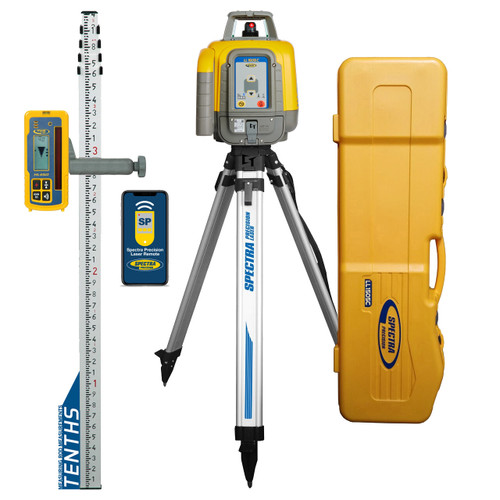
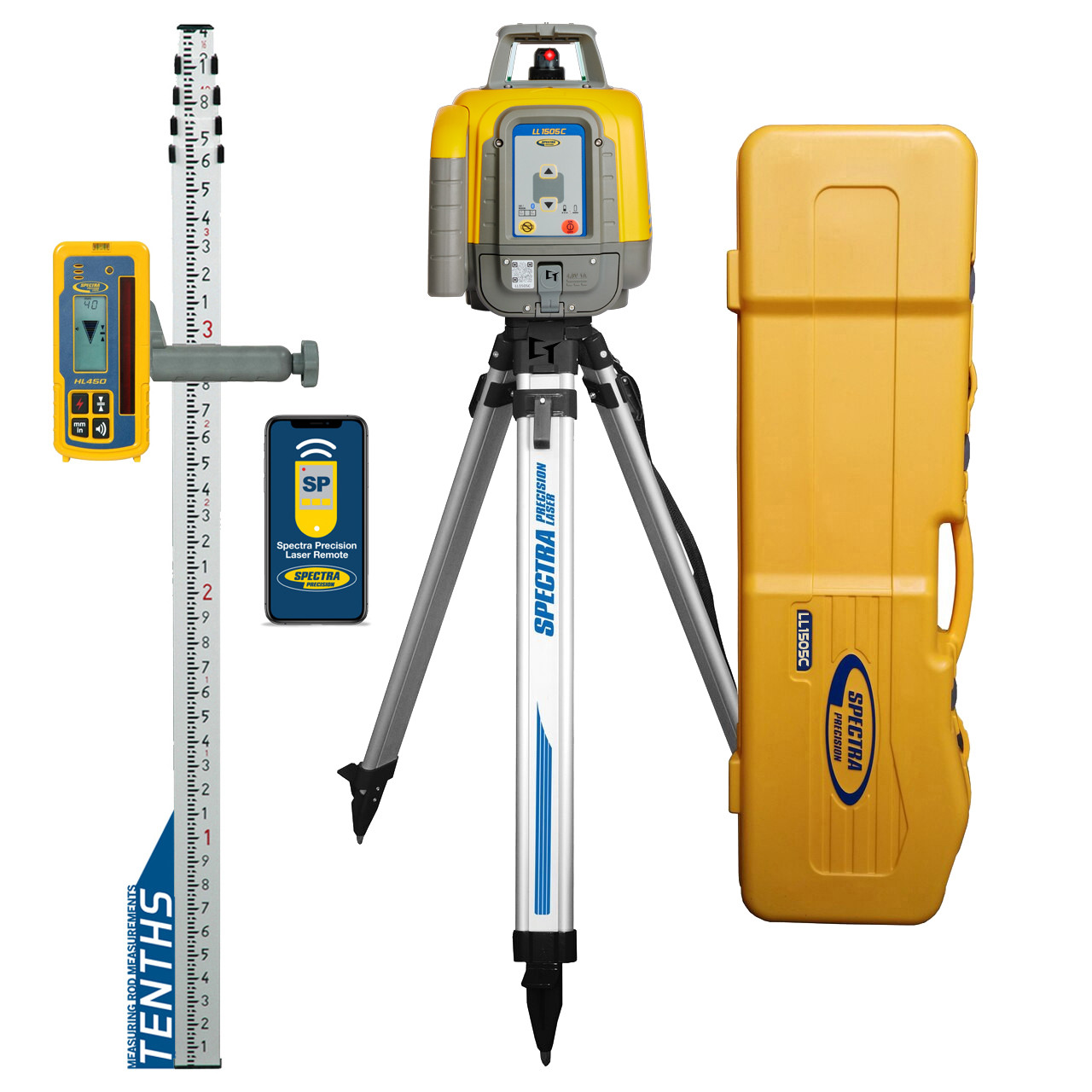
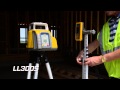
Everything for the job in one box: the LL1505C self-leveling laser, the
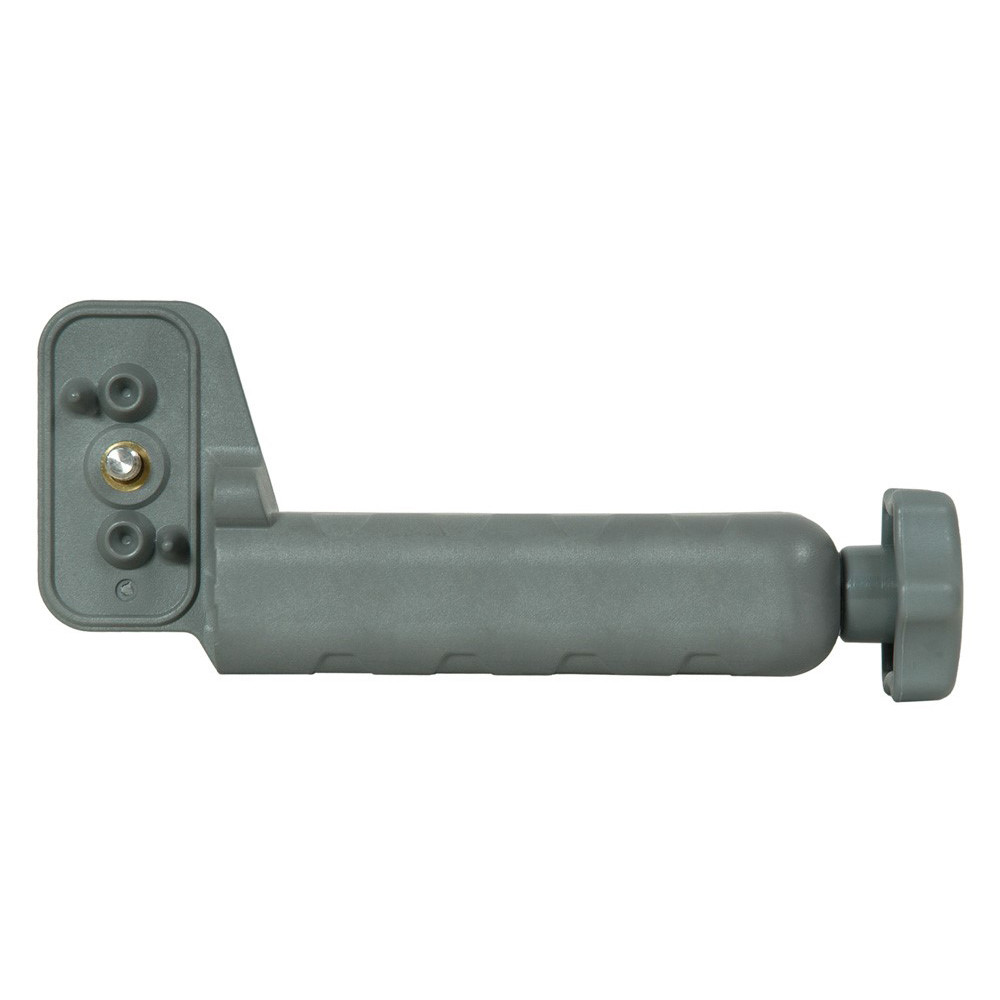
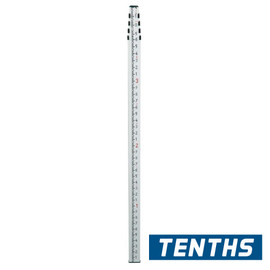
HL450 digital readout receiver with its C45 clamp, four D-cell alkaline batteries, a 15 ft GR151 rod in tenths of a foot, the
Q104025 tripod — and the 128995-00 Large System Case that every one of
them fits inside. Accurate to 1/16″ at 100 ft across a 4,000 ft working diameter,
with Bluetooth so your phone sets the slope.
Questions? Talk to someone who uses these: 1-877-866-5721
±1/16″
At 100 ft
4,000 ft
Working diameter
IP66
Dust & jet rated
4 x D-cell
Batteries included
300/600/900
Rotation rpm
±5°
Self-leveling
5 years
Warranty
One case
Rod + tripod fit
Pour concrete with confidence
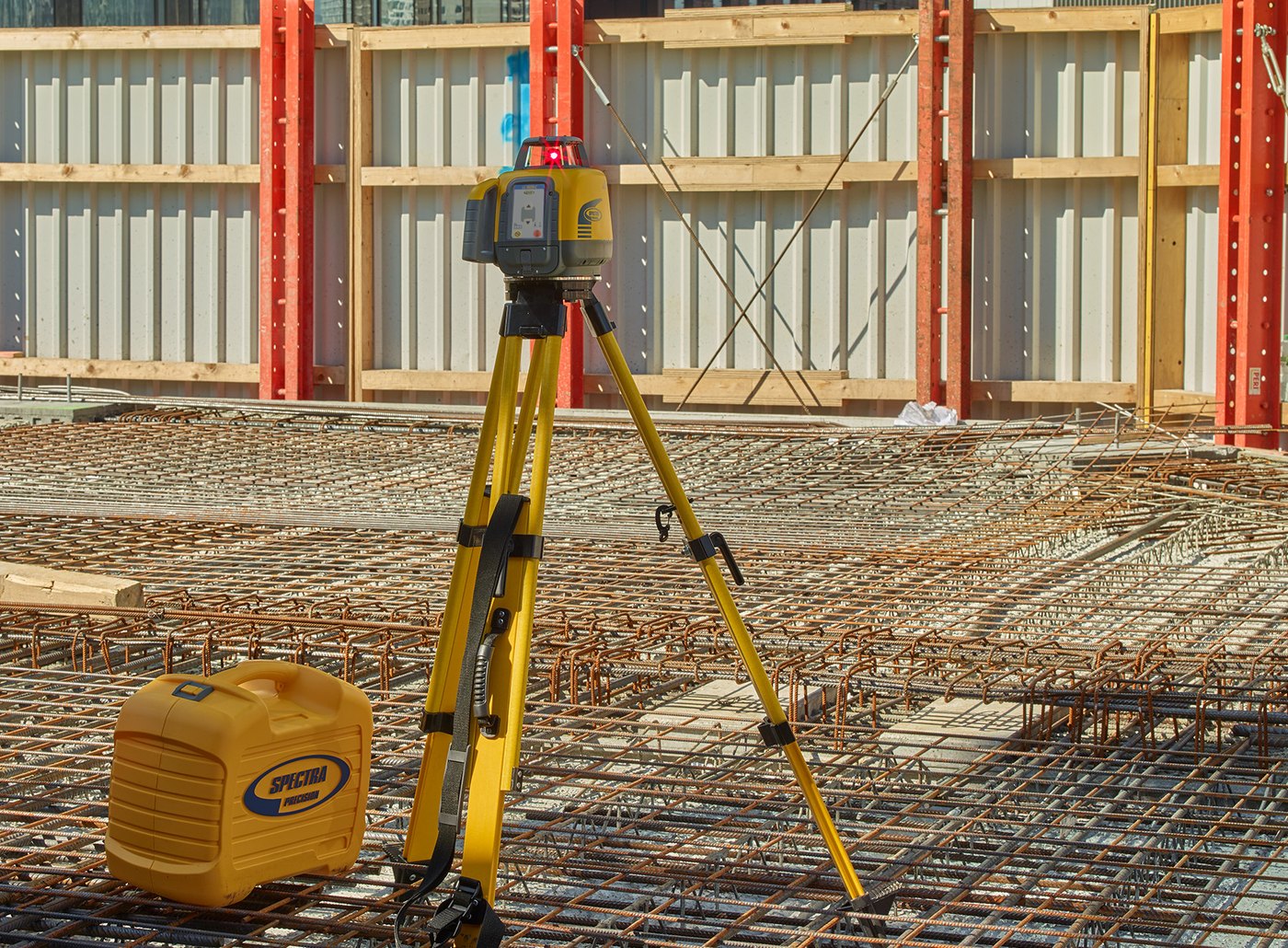
Forms, footings and screed line all off one plane. Set it in the morning and it holds all day.
Get the grade right the first time
Cut and fill read straight off the rod, so nothing gets set on somebody’s guess.
Move dirt with fewer grade checks
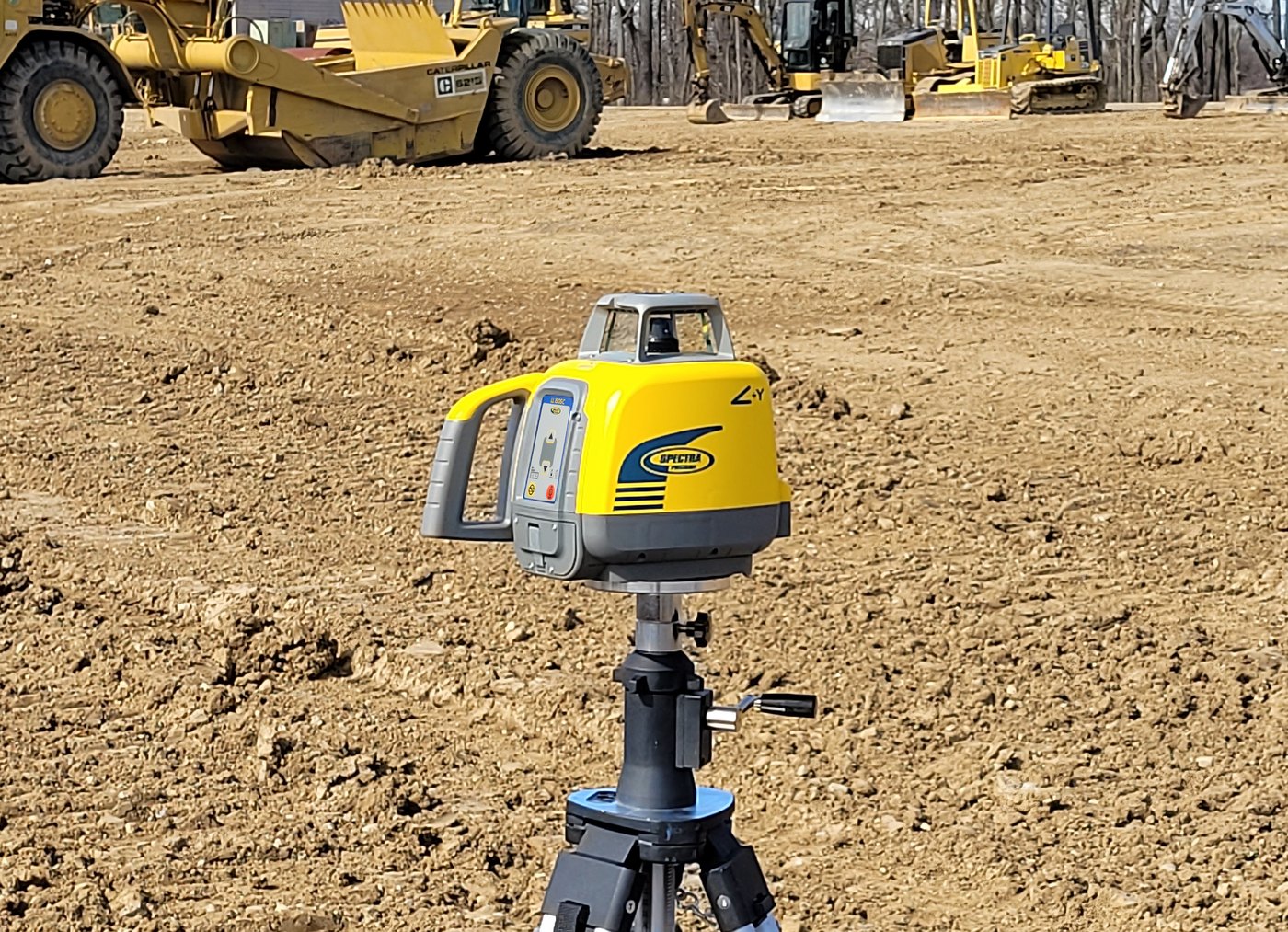
A 4,000 ft working diameter — check from where you are standing instead of walking back to the hub.
The pairing
The laser makes the plane. The HL450 reads it.
LL1505C
It puts the plane up.
Self-levels every time it powers on, so you can never arrive on site working off yesterday’s slope by accident.
1/16″ at 100 ft. 300 / 600 / 900 rpm, and a ±5° self-leveling range.
Manual slope on X and Y, with the direction of each axis cast into the housing.
Bluetooth is built in. Your own phone sets the slope — there is no remote you have to buy first.
A 3 ft drop onto concrete and a 5 ft tripod tip-over, sealed to IP66.
HI alert watches the height of instrument. Knock the tripod and the laser stops and tells you, rather than letting you work off a benchmark that moved.
Mask Mode shuts the beam off in up to three windows, so it does not trip another crew’s receiver on a shared site.
HL450
It tells you the number.
A 4 inch reception window with a 3 inch smart numeric readout display — 1.5 inch on either side of grade. Inside it you get a measurement, outside it arrows and a tone.
Displays in millimetres, centimetres, feet and inches, or fractional inches.
Three precision settings — Fine 1.0 mm (1/16″), Medium 5.0 mm (1/4″), plus a 0.1 mm calibration setting.
Front and rear LCD, so you read it from either side of the rod. Ships with its C45 clamp.
No radio. It reads the beam but does not talk back to the laser, so PlaneMatch is not available on this kit — that needs an HL760 or a CR700.
What the pair does — and the one thing it does not
Range is set by the laser, not the receiver — the LL1505C works across a 4,000 ft diameter and the HL450 reads it out there the same as anything else would. What the receiver decides is what you see: the HL450 gives you a number on a front and rear LCD instead of a beep to interpret.
The one thing it will not do is PlaneMatch. That needs two-way radio between laser and receiver, and the HL450 has no radio. The laser is capable of it, so adding an HL760 or a CR700 later switches it on without replacing anything else.
That pairing is already done for you in the LL1505C-1A — laser, receiver and its clamp come out of the same case.
What you get
The whole job in one case
Laser and receiver
The LL1505C self-leveling laser and the HL450 digital readout receiver with its C45 clamp — the receiver that gives you the number, not just a beep.
Rod, tripod, power
A 15 ft GR151 rod in tenths of a foot, the Q104025 tripod, and four D-cell alkaline batteries. Nothing to charge the night before.
The 128995-00 large case
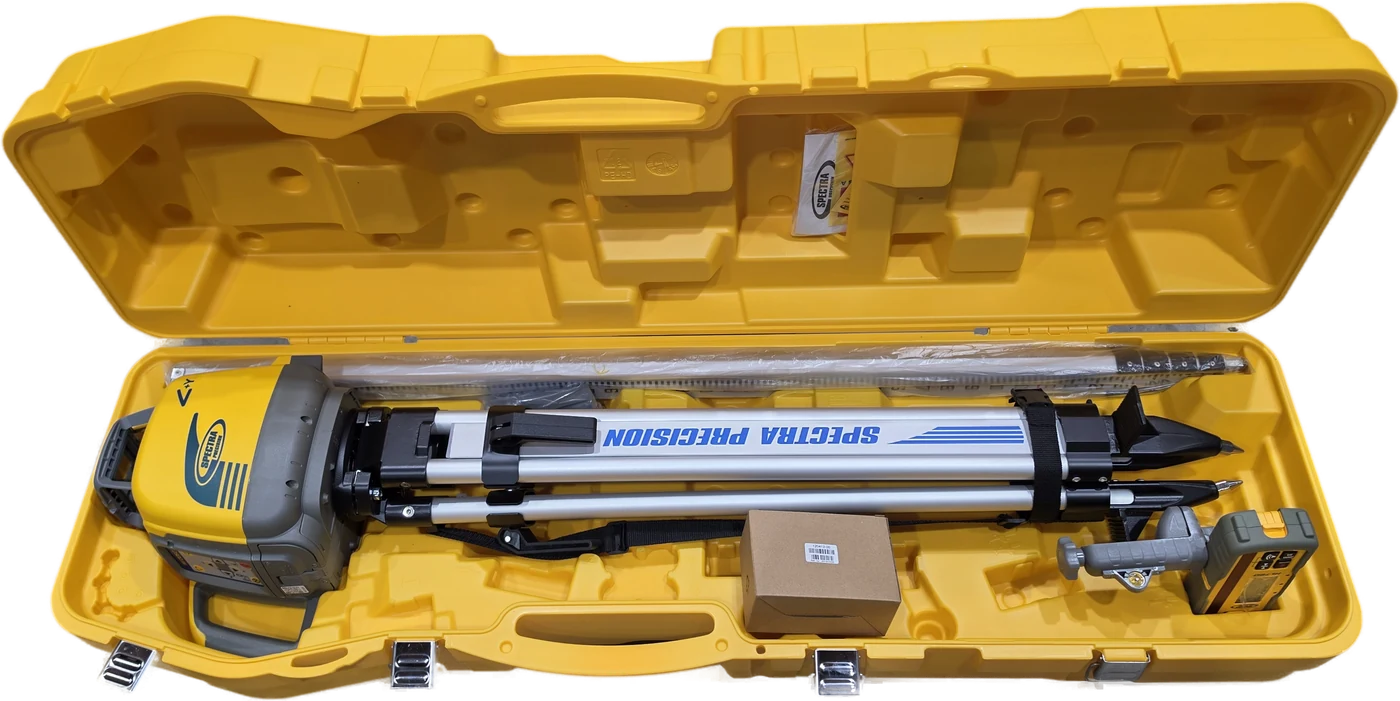
Every piece of it travels inside one case — rod and tripod included. That is what the All in One case is built to do.
One box off the truck and you are working.
The technical edge
288 acres from one setup
Reach
A 4,000 ft working diameter — a circle three quarters of a mile across. Set it once and cover ground that would otherwise cost you three or four moves.
Precision
1/16″ at 100 ft from the laser, and the HL450 reads to 1/16″ on its Fine setting. Tight enough for forms, footers and finish concrete.
Speed
300 / 600 / 900 rpm. The beam only tells a receiver where it is when it sweeps past — 15 times a second at 900 rpm instead of 5 at 300. On a moving machine that is the difference between holding grade and chasing it.
Most lasers make you choose between reach and precision. This one does not.
What sets it apart
Two ways to control your laser
1 · Your phone — free
Bluetooth is built in. The Laser Remote App sets slope, changes rotation speed and reaches nearly every setting in the laser. Nothing extra to buy.
2 · The RC1402 remote
Buttons in your hand and 330 ft of radio that behaves the same every day. It is also the only way to reach radio channel and language — and the one that still works when the phone is flat, gloved-out or back in the truck.
Most crews end up using both. Your choice, not ours.
Free Same-Day Shipping · Order by noon central and it ships today. Call 1-877-866-5721 for express and next-day options. · Five year laser warranty
The 128995-00 large system case. Laser, HL450, GR151 rod and the Q104025 tripod all travel in this one case — the rod and the tripod are what the small and medium cases will not take.
Overview
One Laser. Two Ways to Run It.
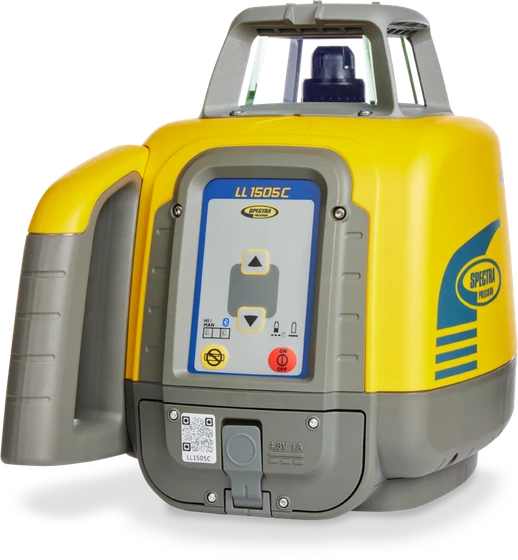
The LL1505C is a self-leveling horizontal laser with
manual slope, built for general and concrete construction. Spectra call it the most rugged laser
level they make: it survives a 1 m (3 ft) drop onto concrete and a tripod tip-over from
1.5 m (5 ft), and it is sealed to IP66 against dust and jetted water.
Two things separate it from a basic rotary laser. It is more accurate and
reaches further — 1/16 inch at 100 feet, and the laser itself transmits across a
4,000 ft diameter if you ever put a longer-range receiver on the rod. And it has Bluetooth built in, so the Spectra Precision Laser Remote App on
your own phone sets the slope and drives the laser. Spectra's own words: it
"eliminates the extra cost of the remote control."
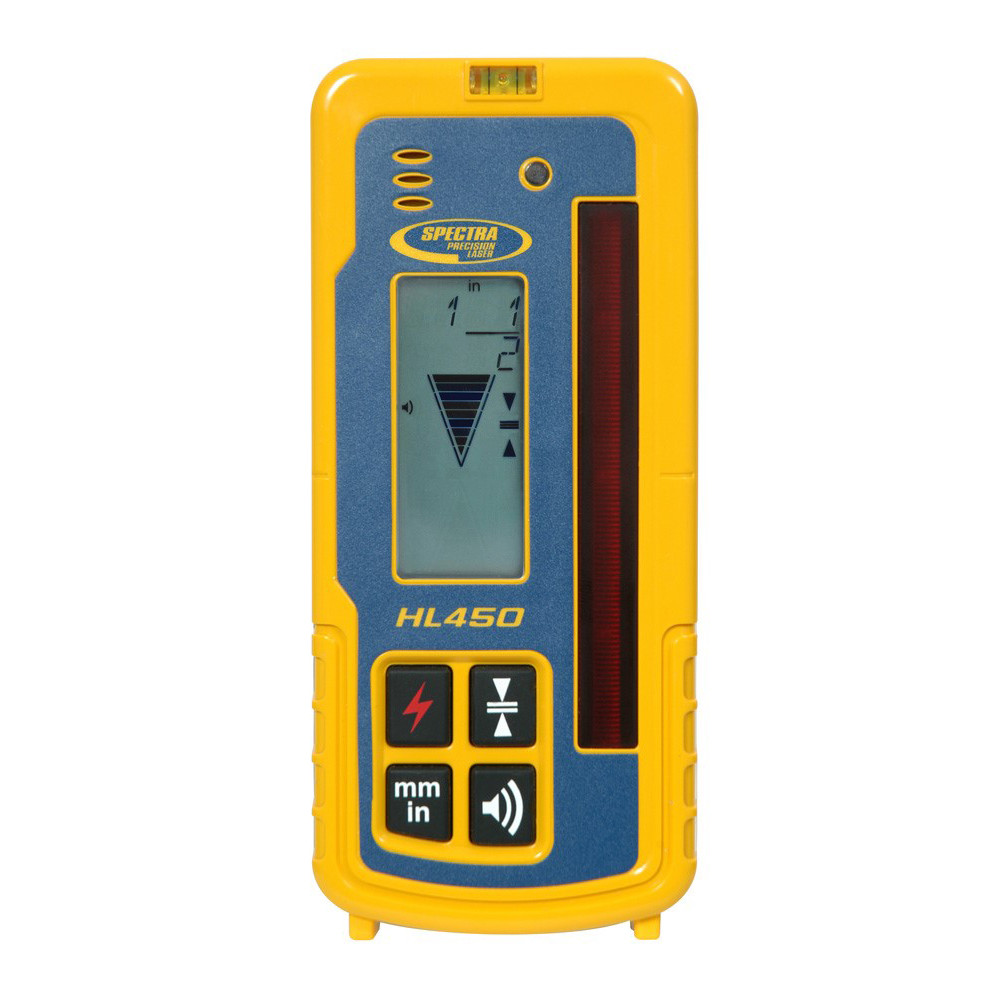
The HL450 in this kit is the receiver that gives you a number rather than a beep: a
3 inch readout band, 1.5 in. either side of grade, on a front and rear LCD.
It has no radio, so PlaneMatch is not part of this kit — that needs an HL760 or a CR700.
What’s in the Box
What You Receive.
LL1505C Laser
Self-leveling rotary laser with manual slope and Bluetooth. 1/16 in at 100 ft, 300/600/900 rpm, IP66, five year warranty.
HL450 Digital Readout Receiver
The receiver that gives you a number: 4 inch reception window, 3 inch smart numeric readout display, three precision settings, front and rear LCD.
C45 Rod Clamp
The rod clamp that ships with the HL450 — it is part of the receiver, not a separate purchase.
4 D-Cell Alkaline Batteries
Buy them anywhere, swap them on the tailgate, and there is nothing to leave on a charger the night before. Spectra do not publish an alkaline runtime — it depends on the brand of cell.
GR151 Grade Rod — TENTHS
15 ft aluminum rod graduated in tenths of a foot. One of only four rods that fit inside the large case.
Q104025 Aluminum Tripod
Medium duty, quick clamps. The only tripod that fits inside the large case — and it is already in this kit.
128995-00 Large System Case
The All in One case: laser, receiver, rod and tripod all travel in one box — no second bag, nothing left on the truck.
Laser Remote App
iOS and Android, free. Bluetooth control of slope, rotation speed and the laser functions from your own phone.
Quick Guide, Safety Instructions and 5-Year Warranty
Multi-language documentation in the box. The laser carries Spectra’s five year no-cost warranty — if it fails inside five years it is repaired free, parts and labor.
LL1505C-1A
Why this kit and not a cheaper one
The rod and the tripod go inside the case.
One box off the truck and you are working — laser, receiver, 15 ft rod and tripod all travel inside the 128995-00 case. That is not true of most kits, and it is not true of most tripods: the Q104025 in this kit is the only tripod that fits inside it. Wood, elevating and heavy-duty tripods will not go in, whatever the badge.
An all-in-one case like this is rare, and it is the reason this kit travels the way it does. If you ever replace the rod, it has to be one of four that fit — GR151 or GR152, or the SitePRO 11-815-T or 11-815-C. Anything else and it stops traveling in the case. Buy the kit and you already have the right ones.
This kit reads in TENTHS of a foot. Need feet and inches instead?
The LL1505C-2A is the identical kit — same LL1505C laser, same receiver and clamp, same B10 pack and CH10 charger, same Q104025 tripod, same 128995-00 large system case — with the GR152 inches rod in place of the GR151. If your plans and your crew work in feet and inches — most residential and flatwork does — that is the one you want. Ordering the wrong scale is the most common reason one of these comes back.
Cut and fill, building pads, sub-base and sub-grade elevations
Drainage & Pipe Laying
Storm drains, septic fields, footers and trench depth
Forms & Footers
Leveling and aligning forms and footers to a single reference
Driveways & Ramps
Basic slopes — the single axis slope mode is built for exactly this
Estimating Cut and Fill
Read the number off the rod and work the quantity before you move dirt
Concrete & Slab Work
General elevation control across small to medium job sites
Applications as Spectra list them on the
LL1505C datasheet.
VIDEO
See It On the Job.
Spectra’s own field footage. Pick one and it plays here.
The longest of the four and the one to watch if you are choosing between this and a cheaper laser. Two practical ways the LL1505C stops an unchecked elevation turning into a repour, shown on site rather than argued on a spec sheet.
Concrete work — one instrument holding elevation across forms, footers and rebar.Site grading — a 4,000 ft working diameter, so the machines move and the laser does not.
SLOPE
Slope, Three Ways — and Only One Needs the Remote.
The LL300N does manual slope. The LL1505C does manual slope, single-axis slope with the other axis still self-leveling, and PlaneMatch, which works the grade out for you. They are three different jobs and they are worth keeping straight. Two of the three work with the LL1505C-1A exactly as it ships — PlaneMatch is the exception, because it needs a radio receiver and the HL450 in this kit does not have one.
✚︎
Manual Mode — both axes
Press the manual button once. Self-leveling stops and the arrow keys tilt both axes. For matching an existing non-level surface, a reference hub, or an elevation that was never level to begin with. The MAN indicator flashes red once a second so the laser can never be mistaken for a self-leveling one.
PRESS MANUAL ×1
◢︎
Single Axis Slope — the ramp mode
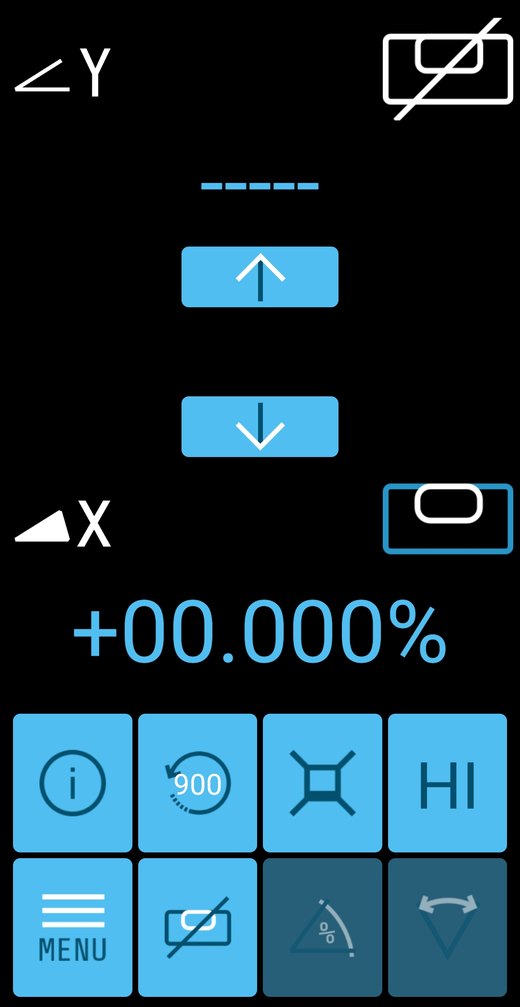
Press the manual button twice. The Y axis goes to manual and the X axis keeps self-leveling — so your fall runs true down the drive while the laser still holds itself level across it. Red and green flash together, once a second. This is done at the laser. No remote, no phone.
PRESS MANUAL ×2
⇄︎
PlaneMatch — it works the grade out (needs a different receiver)
You do not calculate the fall. Set the receiver on the first point, then the second, and the laser matches the existing grade between them over ground you have not measured. Spectra’s own words: it “eliminates the need for complex calculations and will avoid errors.” Needs an HL760 or CR700 receiver, driven from the free app or the RC1402.
APP OR RC1402 + HL760/CR700
The number almost nobody lists
Slope range: ±9% (5°)
Spectra print this figure in exactly one place — the User Guide troubleshooting table, under error 130, “Check if the receiver was set out of the slope range (+/- 9%, 5°).” It is not on the datasheet and not on Spectra’s website, which is why you will struggle to find it anywhere else. It is the same envelope the compensator uses to self-level (±5°, ±8.7% on the datasheet), but Spectra state it separately for slope, so we list it separately.
THE RECEIVER
The HL450 Gives You a Number, Not Just a Beep.
A basic receiver beeps at you and leaves you to work out the rest. The HL450 puts a number on the screen. It is the first receiver in Spectra’s range that reads out the distance off grade instead of only pointing at it — in millimetres, centimetres, feet and inches, or fractional inches, whichever your job runs in.
Two numbers describe it and they are not the same number. The reception window is 4 inch — that is the band over which it detects the beam at all, and a wide window is what lets you find the beam quickly coming up the rod. The smart numeric readout display is 3 inch, 1.5 inch on either side of grade. Inside that band you get a measurement. Outside it you still get arrows and a tone telling you which way to move. Most listings quote only one of these two figures.
There is an LCD on the front and on the back, so you read it from whichever side of the rod you are standing on, and three precision settings so you can hold finish tolerance on concrete and stop chasing hundredths in rough dirt.
What it does not do, so you are not surprised: the HL450 has no radio. It reads the beam, but it cannot talk back to the laser — so PlaneMatch is not available on this kit. PlaneMatch needs a two-way receiver like the HL760 or the CR700. It also has no coloured grade lights; it works on the readout, the arrows and the tone.
See it work
The screen, without the glare.
The beam sweeps the full 102 mm (4 in) reception window. The
number is live only over the middle 76 mm (3 in) — watch it blank to
–– at the extremes while the arrows keep working. The grade triangle lights
segment by segment: more segments the further off grade, fewer as you close in.
Reception window · 102 mm
The same screen, magnified
Receiver is
ON GRADE
Tone
Solid
Accuracy setting
Fine
1/16 in · 1.0 mm Medium is 1/4 in · 5.0 mm
The triangle is a distance gauge. It grows the further you are off grade
and shrinks as you close in, so you can work off its size without reading the number. The tone says
the same thing without looking: fast beeping = low, solid tone = on grade,
slow beeping = high.
HL450
Included in this kit
Total reception height
4 in. (102 mm) — Spectra call it the SuperCell window. This is the band over which it sees the beam at all
Numeric readout height
3 in. (76 mm) — ±1.5 in. either side of grade. Inside this band you get a measurement; outside it you get the arrows
Precision settings
Three — Fine 1.0 mm (1/16 in.), Medium 5.0 mm (1/4 in.), plus a Calibration setting at 0.1 mm (1/64 in.)
Display units
Millimetres, centimetres, feet and inches, or fractional inches
Displays
Front and rear LCD — the back repeats the front, so you read it from either side of the rod
Reception angle
±45° minimum
Working radius
Laser dependent. Spectra quote 1–200 m (3–650 ft) for the receiver in general; on the LL1505C you have the laser’s full 4,000 ft working diameter
Laser compatibility
Any rotating laser in the red spectrum, 610–900 nm — not just Spectra
Radio
None. The HL450 reads the beam; it does not talk back to the laser
Anti-strobe sensor
Patented filter rejects false strikes from LED and hazard strobes
Marking notch
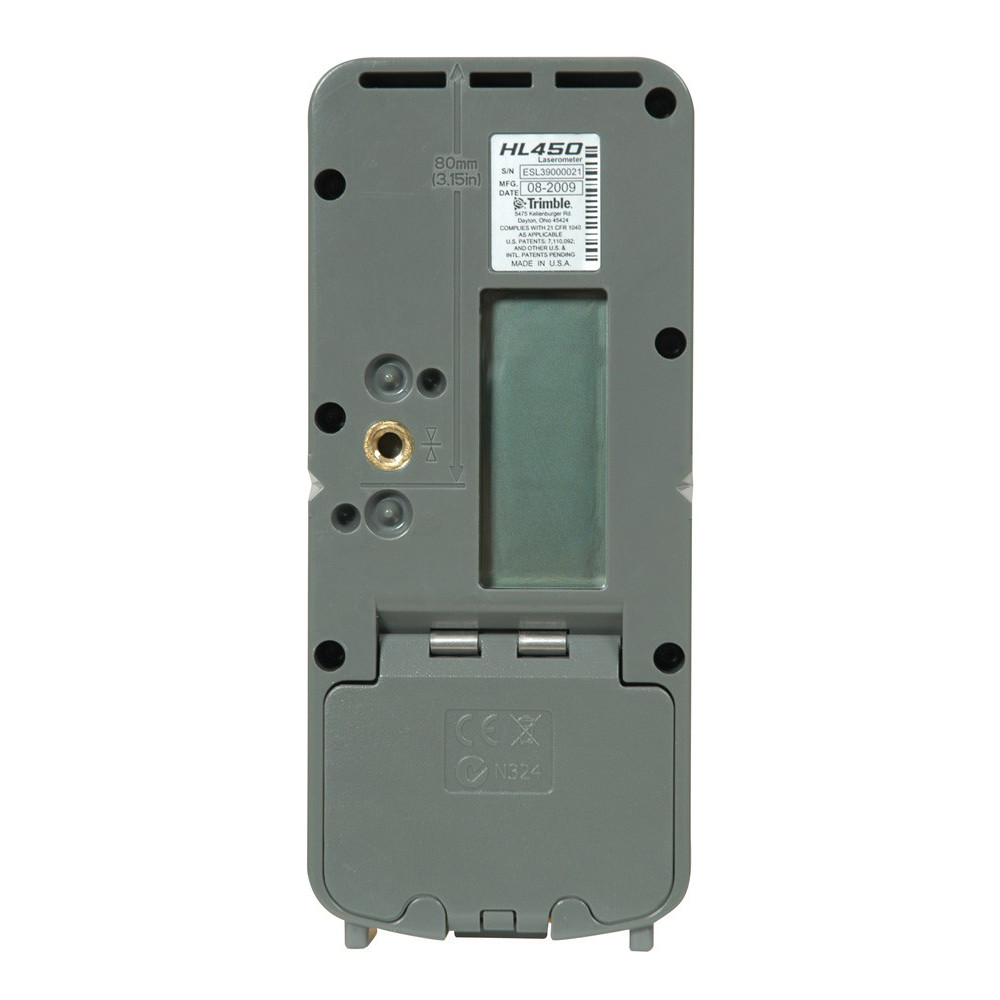
3.15 in. / 80.0 mm from the top
Beeper
Three volume settings — loud 100+ dBA, low 65 dBA, or off
Power
2 × 1.5 V AA. 70+ hours. Auto shut-off at 30 minutes
Environmental
IP67 waterproof and dustproof
Drop rating
5 ft (1.5 m) onto concrete
Clamp
C45 rod clamp included — it is part of the receiver, not an extra
Warranty
3 years limited — 2 years free exchange, a fee applies in the third
✓ HL450 receiver and C45 clamp are included in this kit
Hover any photo to enlarge it.
It is not locked to this laser, or to this brand
It reads any red beam rotary laser you own.
The HL450 detects the 610–900 nm red spectrum, which is all it needs to be. Put it in front of any red beam rotary laser and it reads the beam — Topcon, Hilti, Leica, Johnson, David White, DeWalt, Milwaukee — whatever badge is on the case. If you already run a rotary laser, this receiver works on it today — and if you later move up to a bigger Spectra laser, it comes with you.
Two things it will not do. It is a rotary-laser receiver: it does not work with pipe lasers, and it is not a machine-mounted receiver. And with no radio on board it cannot run the two-way features — PlaneMatch needs an HL760 or a CR700.
Range and accuracy, together
From a single footing to a subdivision — without moving the tripod.
The LL1505C works across a 4,000 ft diameter. That is a circle three quarters of a mile across — roughly 288 acres from one setup. Set it once in the morning and it covers ground that would otherwise cost you three or four moves.
That reach comes from the laser, not from the receiver on the rod. What the receiver decides is what you get when the beam arrives — and the HL450 gives you the distance off grade as a number, on a front and a rear LCD, instead of a tone you have to interpret.
Accuracy holds all the way out: 1/16 inch at 100 feet from the laser, with the HL450 reading to 1/16 inch on its Fine setting. Tight enough for forms, footers and finish concrete.
Why fewer setups means fewer mistakes
Every time you move the laser you re-establish your height of instrument, and every one of those is a chance to be a fraction out. Cover more ground from one position and you carry one benchmark across the whole job instead of four.
Accurate the first time is cheaper than accurate the second time. Concrete does not get poured twice.
IN THE MANUAL
Six Things in the Owner’s Manual Most Sellers Never Mention.
None of these are on the datasheet. All of them are in the book that comes in the case, and every one of them is a reason this laser is easier to live with than the spec sheet suggests.
◧︎
Mask Mode — shut off part of the beam
Electronically kills the beam in one, two or three of the four quarters. Two uses: you stop blinding the crew working off their own laser next door, and you stop your own beam bouncing off glass or glossy metal back into your receiver as a false reading.
ARROW THEN MANUAL
⏸︎
Standby — a proper lunch break
Beam off and leveling stopped to save the pack, but the HI alert keeps watching and your setup is preserved. It cancels itself if the laser gets re-oriented, so it can never quietly hide a knock while you are away.
HOLD MANUAL 3 SEC
☰︎
Sensitivity — three levels
This does not change how accurately it levels. It changes how much wind and machine vibration the laser tolerates before it cries HI. Set it low-sensitivity beside a running dozer and it stops nuisance alarms without giving up a thing on accuracy. And the naming misleads: Low sensitivity is not less accurate — it is the setting that keeps the HI alert usable in wind.
APP OR RC1402
◉︎
Six radio channels
Channels 0 to 5. If you are on a site with several lasers running, or somewhere with enough radio traffic to upset a link, you move channel instead of fighting it.
RC1402 SETTINGS
⚠︎
HI / shock alert
Rotation stops, the beam goes off, you get an audible warning, the LED flashes every 4 seconds and the remote shows HI. It is the difference between finding out now and finding out after you have poured.
ALWAYS ARMED WHEN LEVEL
ℹ︎
The Info screen
Hold E on the RC1402 and the laser reports model, battery, internal temperature, three firmware revisions, internal serial number and total runtime hours. Worth knowing before a warranty or service conversation. The free app shows all of it too — and runtime hours are worth asking for before you buy a used laser, because it is the one number that cannot be polished.
APP OR RC1402
Worth Knowing
Before It Comes Out of the Case.
Worth knowing before it comes out of the case
It always wakes up level
Whatever you left it in last night, the LL1505C
powers on in automatic self-leveling every time. You cannot arrive on site working off yesterday’s
slope by accident — and masking clears at power-on too.
It works stood on its side
The mount is 5/8 × 11 both ways up, so the
same laser does plumb, walls and layout. Stood vertical it runs in manual — it cannot self-level on
its side — so the arrow keys drive it directly: up and down sets the vertical slope, left and right
walks the line sideways across the wall.
The casting shows you which way each axis runs
There are slope indication marks moulded into the
housing marking positive Y and positive X. They tell you the direction a Y adjustment will
tilt the beam, and the same for X — so you can line the laser up with your fall
before you touch a button, instead of finding out you have sloped across the drive rather than
along it.
SPECIFICATIONS
Every Number, From Spectra’s Own Documents.
Taken from the LL1505C datasheet and the LL1505C User Guide. Where a figure appears in only one of them, we say so rather than round it off.
►︎ ACCURACY & RANGE
Accuracy
±1.5 mm / 30 m — 1/16 inch at 100 ft — 10 arc seconds
Operational diameter
4,000 ft (1,200 m). This is a property of the laser, not of the receiver on the rod
Self-leveling range
±5° (±8.7%)
Slope range
±9% (5°) — single axis or manual
Rotation speed
300 / 600 / 900 rpm, selectable — set from the RC1402
Laser
630–643 nm, Class 2
►︎ CONTROL
Bluetooth
Built in — free Spectra Precision Laser Remote App, iOS and Android
Radio range
Up to 100 m (330 ft) — the RC1402 / HL760 radio, not Bluetooth. Not used by this kit: the HL450 has no radio, which is what PlaneMatch needs
PlaneMatch distance
Typically 80 m (260 ft) — needs an HL760 or CR700, so not available with the HL450 in this kit
Radio channels
Six (0–5)
►︎ POWER
Power source
4 × D-cell alkaline (included). The B10 NiMH pack and CH10 charger fit this laser and are sold separately
Battery life
Spectra publish 55 hours typical for the B10 NiMH pack. They publish no figure for alkaline — it depends on the brand of cell
Charge time
Under 10 hours — charges inside or outside the laser
Charger
Not included — this kit runs on alkalines. The CH10 is sold separately if you add a B10 pack
►︎ BUILT TO BE DROPPED
Drop rating
1 m (3 ft) onto concrete
Tripod tip-over
1.5 m (5 ft)
Environmental rating
IP66 — dust tight, protected against jetted water
Operating temperature
-4°F to 122°F
Storage temperature
-13°F to 158°F
Out-of-level warning
Rotor stops and the red HI/MAN LED flashes
►︎ PHYSICAL
Weight
7.7 lb (3.49 kg) including the battery
Dimensions
10.7 × 7.7 × 7.9 in
Mount
5/8 × 11 horizontally and vertically
Warranty
5 years — no cost, parts and labor
The slope range figure is published only in the User Guide troubleshooting table (error 130). It is not on the datasheet.
Compare the Series
Which LL1505C Do You Need?
Every LL1505C package we build, in one place. They all use the same laser — what changes is the receiver, whether a rod and tripod come with it, and which case it lives in. Find the row that matches how you work.
Prices are live from each product page. TENTHS reads in tenths of a foot; INCHES reads in feet and inches. Receiver tiers: HR320 good, HL450 better, CR700 and HL760 best — the HL760 and CR700 are the two that unlock PlaneMatch.
Read This First
Two Things Worth Knowing.
Two ways to control it — and one limit on both.
The free Laser Remote App runs this laser over Bluetooth —
slope, rotation speed, sensitivity, the HI alert, even field calibration. We
connected a phone and checked every screen. Two things it cannot reach: radio channel and
language. Those are
RC1402
only — and so is a radio that reaches 330 ft and behaves the same every day,
where Spectra put the app at 150 ft for setting slope — a good day, not a guarantee, because Bluetooth moves with the weather, whatever is in the way, and the handset in your hand.
Connecting has one trick worth knowing before you are standing in
a field wondering why it will not pair: the laser only listens for a phone during the first
30 seconds after power-on. Miss that window and you cycle the power — nothing is broken.
First run also wants the license accepted and GPS switched on at the phone. Once it is
talking, the status light on the laser turns blue.
Manual slope, not automatic grade entry.
You tilt the beam and verify it on the rod — there is no field
to type "1.5%" into. The app will show you a slope percentage on its first screen and it will not
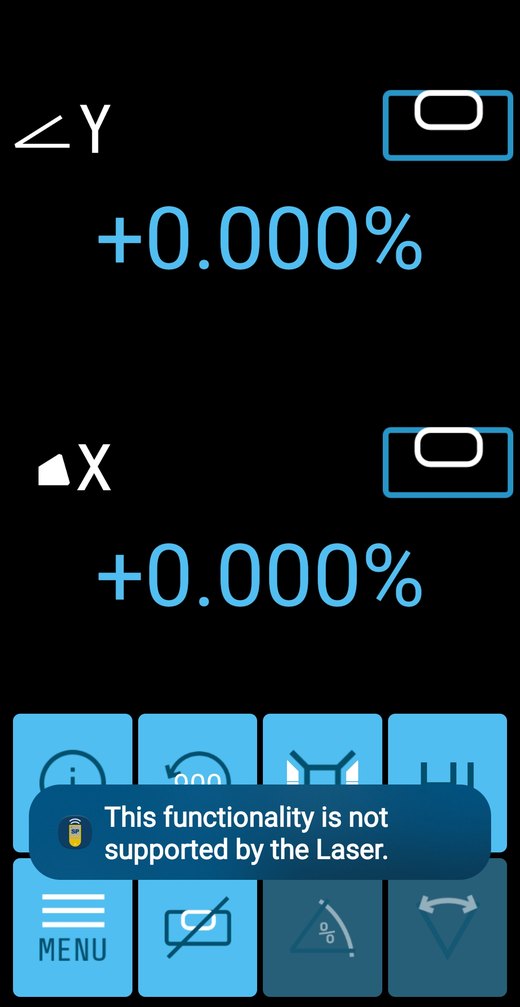
let you set one: tap it and the laser answers "This functionality is not supported by the
Laser." That readout is there because one app runs Spectra's whole range.
What you do instead: Single Axis Slope, on the laser itself — press the manual button
twice and the Y axis tilts while X keeps self-leveling. If you need to dial an exact
percentage and have the laser hold it, you want an automatic slope laser. Call
1-877-866-5721 and we will point you at the right one rather than let you buy twice.
BLUETOOTH CONTROL
You Cannot Type a Grade Into This Laser.
The LL1505C has Bluetooth built in and a free app — the Spectra Precision Laser Remote, on iOS and Android. It does more than most people expect. But there is one thing it does not do, and it is the reason our phone rings, so we are going to lead with it rather than bury it.
Read this before you order
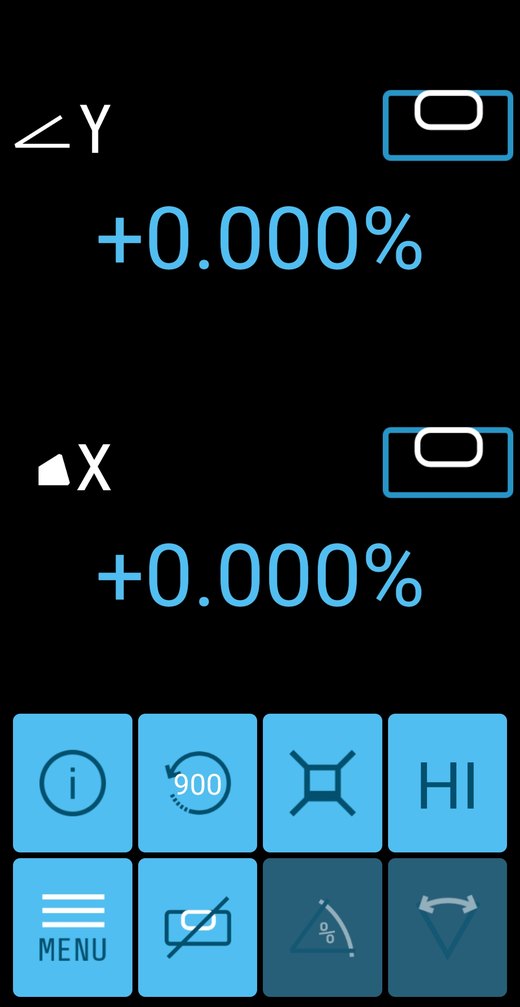
The app opens on a screen showing a slope percentage — ∠Y +0.000% and ◢X +0.000%. People quite reasonably try to type a grade into it. You cannot. The LL1505C is a manual slope laser and it does not accept a typed percentage.
Look at the bottom row of the first screen: the % tile is grayed out. That is Spectra’s own app telling you. Tap it anyway and the laser answers “This functionality is not supported by the Laser.”
It is there because one app runs Spectra’s whole laser range, and the models above this one do take a typed grade. This one does not.
What to do instead: use Single Axis Slope and tilt with the arrows, checking it on the rod — or let PlaneMatch work the grade out for you with an HL760 or CR700.
If you genuinely need to dial in 1.5% and have the laser hold it, you want an automatic slope laser — not this one. Call us on 1-877-866-5721 before you order, not after.
The screen the app opens on. Note the grayed-out % tile, bottom row.Tap it and the laser tells you plainly.
Now the good part — what it actually does.
Spectra’s datasheet says the Bluetooth “eliminates the extra cost of the remote control.” On this laser that is very nearly true, and we checked every screen to be sure.
No phone, no remote
At the Laser Itself
Power on — always starts in automatic self-leveling
Manual mode, both axes — manual button ×1
Single Axis Slope — manual button ×2. The ramp mode needs nothing else at all.
Mask Mode and Standby
If sloping a drive is what you came for, the laser already does it on its own.
The free app does all of this
App or RC1402
PlaneMatch — with an HL760 or CR700
Rotation speed — 300 / 600 / 900 rpm
Setting manual slope on your own — Spectra put the app at 150 ft for this
HI alert delay, sensitivity, mask, standby, all three slope modes
Field calibration of the X and Y level sensors
Runtime hours, serial number, firmware, internal temperature
Share Logs — email the laser’s own fault log to us
Spectra’s printed manual says several of these need the remote. They do not — the app has moved on since the book was written.
What the app cannot reach
The RC1402 Only
Radio channel — for sites running several lasers
Language — 14 of them: English, German, Italian, French, Spanish, Portuguese, Dutch, Danish, Norwegian, Swedish, Finnish, Polish, Turkish and Czech
330 ft of radio that behaves the same every day — more than twice the app
Working when the phone is flat, gloved-out or back in the truck
A shorter list than Spectra implies. We would rather you bought one for the right reason than returned it for the wrong one.
Single Axis Slope: Y under your arrows, X still self-leveling.
This is the mode you want for a drive or a ramp. Hold the arrow and the beam walks up or down on Y — and X never stops self-leveling. While you set your fall, the laser is still watching your cross-axis and still protecting it.
Compare that with full manual mode, where Spectra’s own warning reads: “the laser is not self-leveled… there is no control for the slope accuracy and no warning for the Height of the Instrument (HI-alert).”
Every axis you take manual control of, you also take responsibility for. In single axis you hand over one and keep the guard on the other. In manual you hand over both, and nothing tells you if the tripod gets bumped — not the beam, not the alert, not the receiver. You find out when the concrete is wrong.
The whole app, screen by screen
We connected a phone to an LL1505C and photographed every screen in the app — every menu, every setting, what each one does on this laser and which ones do nothing. Read the full LL1505C app guide → Documented against Laser Remote app version 2.1.14, September 2026. Spectra update the app; if you spot a difference, tell us and we will correct this page.
LED REFERENCE
Reading the Lights.
These are the laser’s own panel indicators, written the way Spectra document them. Match what you see to the row and you know the state of the machine without walking over to it.
Indicator
What it means
Green, flashing 1/sec
Self-leveling is running. Give it a moment.
Green, solid
Level and inside accuracy. Solid for the first 5 minutes after leveling.
Green, flash every 4 sec
Level and HI alert armed. This is the state you want to see all day.
Red, flashing 1/sec
Manual mode. The laser is not self-leveling — both axes are under your arrows.
Red and green together, 1/sec
Single Axis Slope. Y is under your control, X is still self-leveling.
Red every 5 sec
Standby. Beam off to save battery, setup preserved, HI still watching.
Red, flashing with a tone
HI / shock alert. Something moved the laser — a bumped leg, a sinking tripod foot. Rotation stops and the beam goes off on purpose. Re-level and check your benchmark before you trust another reading.
Blue
A phone is connected over Bluetooth.
QUICK REFERENCE
Every Button, and What It Does.
You do not need this to buy the laser. You will want it the first week you own one, standing over the thing trying to remember how to get back out of manual mode. Print it, or keep this page bookmarked on your phone.
Everything here is done at the laser itself unless the row says otherwise — and the two rows that mention the RC1402 can also be done from the free app. The full manual is in the downloads below, and it is built into the app as well.
What you press
What the laser does
Hold power 2 seconds
All LEDs light for 2 seconds. The laser always starts in automatic self-leveling — you cannot leave it in slope by accident overnight.
While self-leveling
Status LED flashes once a second.
Once it is level
Solid for 5 minutes, then a flash every 4 seconds — that slow flash means level and HI alert armed.
Manual button ×1
Manual mode. MAN flashes red 1/sec. Arrows tilt both axes.
Manual button ×2
Single Axis Slope. Red and green flash together 1/sec. Up/down slopes Y; X keeps self-leveling.
Manual button ×3
Back to automatic self-leveling.
Hold manual 3 seconds
Standby. Beam off, leveling stopped, batteries saved — but the HI alert stays live and your setup is kept. Hold 3 seconds again to come back.
Arrow, then manual within 1 second
Masks that quarter of the beam. Masking always clears at power-on — yesterday’s mask never follows you to today’s job.
M → Rotation → 300/600/900 → E
Rotation speed. The guide names the app or the RC1402 for this. Factory setting is 900 rpm, and it restarts on the last speed used.
M → PlaneMatch → E → E
Runs PlaneMatch; ends in Single Axis Slope. Exit with manual ×2. Needs an HL760 or CR700 — not the HL450 in this kit.The app does this too.
Hold E on the RC1402
Info screen: rotation speed, internal temperature, battery, firmware and total laser runtime hours.
QUESTIONS & ANSWERS
LL1505C Questions We Actually Get.
Grouped so you can find yours. Buying questions first, then how to work it, then what to do when something is wrong.
Before You Buy 10
Does the LL1505C kit come with a grade rod or a tripod?
Yes, both, and that is the point of this kit. It is the LL1505C laser, the HL450 receiver with its C45 clamp, four D-cell alkaline batteries, a 15 foot GR151 rod graduated in tenths of a foot, the Q104025 aluminum tripod, and the 128995-00 large system case that every one of those pieces travels inside. The Q104025 is the only tripod that fits in that case, and it is already in the box, so you are not buying a case and then finding your tripod will not go in it.
How much slope can the LL1505C actually do?
Plus or minus 9 percent, which is 5 degrees. Spectra publish that figure in one place only, the User Guide troubleshooting table under error 130, so you will struggle to find it anywhere else. It is the same envelope the compensator uses to self-level, but Spectra state it separately for slope so we list it separately.
Can I type in a slope percentage such as 1.5 percent?
No. The LL1505C is a manual slope laser. You tilt the axis with the arrow keys and verify the fall on the rod. If you need to dial an exact percentage into the laser, you want an automatic slope laser. Call 1-877-866-5721 and we will point you at the right one rather than let you buy twice.
Do I need the RC1402 remote, or is the phone app enough?
The free app does more than most people expect. The User Guide names the app alongside the remote for rotation speed, so do not let anyone sell you an RC1402 for that. What the app cannot reach is the Settings menu, which holds sensitivity, radio channel, backlight and language, and the Info screen with internal temperature, firmware and total runtime hours. The remote also gives you a 330 ft radio link that behaves the same every day. Spectra publish 150 feet for setting manual slope from the app on this laser, and that is the figure we quote, but treat it as a good day rather than a guarantee: Bluetooth range moves with the weather, with whatever is standing between you and the laser, and with the phone in your hand. Our advice is to get the app on day one and add the remote when you want the settings, the diagnostics, or a link that does not care what phone you carry.
How far will the LL1505C-1A reach?
A 1,200 meter working diameter, which is 4,000 feet. That is a property of the laser and not of the receiver on the rod, so it is the same figure whichever receiver you put in front of it. It is roughly two and a half times the working diameter of the LL300N series. What the receiver changes is what you see when the beam arrives: the HL450 in this kit gives you the distance off grade as a number rather than a tone to interpret.
Does the LL1505C-1A do PlaneMatch?
No, and it is worth knowing before you buy. PlaneMatch makes the laser match a grade that already exists: you set the receiver on your first point and then your second, and the laser works out the fall between them over ground you have not measured. It needs two way radio between the laser and the receiver, and the HL450 in this kit has no radio at all. PlaneMatch needs an HL760 or a CR700 receiver plus the RC1402 remote. The laser itself is capable of it, so adding the receiver later turns it on without replacing anything else.
Does the LL1505C-1A come with rechargeable batteries?
No, and that is the point of this version. It ships powered by four D-cell alkaline batteries, which cost less up front. You buy replacements at any hardware store, you swap them on the tailgate, and there is nothing to remember to put on a charger the night before. If you would rather run rechargeable, the B10 10,000 mAh NiMH pack and the CH10 worldwide charger both fit this exact laser and are listed in the parts section below, so you can add them whenever you want without changing lasers.
Can the LL1505C be used vertically?
Yes. It mounts 5/8 by 11 horizontally and vertically. In vertical setup the up and down arrows set vertical slope and the left and right arrows move the line left and right, so it is a genuine second application rather than a footnote.
Is the LL1505C more accurate than the LL300N?
Yes, and by a clear margin. The LL1505C holds 1/16 inch at 100 feet against the LL300N at 3/32 inch, and it works across a 4,000 ft diameter against the LL300N's 1,650 ft. It also gives you three rotation speeds and Bluetooth, neither of which the LL300N has.
How long is the warranty on the LL1505C?
Five years, and it is a no-cost warranty: no charge for parts and no charge for labor. If the laser unit fails inside those five years you send it back and it is repaired free. The HL450 receiver carries its own three year limited cover on top of that, with two years free exchange and a fee in the third.
Using Your LL1505C 8
Can I run the LL1505C on alkaline batteries?
Yes, and four D-cell alkalines are in the box as backup. Lift the four D-cell alkaline batteries out and the D-cells slide straight into the compartment. There is no tray, no adapter and nothing extra to buy. Figure on about 45 hours from a charged NiMH pack and about 90 hours on alkalines. The one thing that will destroy the laser is building alkaline cells into the B10 pack's own housing, because the charger will then try to charge them. Spectra's manual is blunt about it: severe damage to the unit will result if charging is attempted.
How do I set single axis slope without a remote?
Press the manual button twice at the laser. The red and green indicators flash together once a second, the Y axis comes under your arrow keys and the X axis keeps self-leveling. Press manual three times to go back to full automatic. The remote is not needed for this.
What is the difference between the HL450's 4 inch window and its 3 inch readout?
They are two different numbers and most listings only quote one. The 4 inch figure is the total reception height, the band over which the receiver detects the beam at all, and a wide window is what lets you find the beam quickly coming up the rod. The 3 inch figure is the numeric readout band, 1.5 inches above grade and 1.5 inches below. Inside that band the HL450 shows you an actual measurement. Outside it, and out to the full 4 inches, you still get the arrows and the tone telling you which way to move, you just do not get a number.
What do the laser's lights mean?
Green flashing once a second is self-leveling. Green solid is level, for the first five minutes. Green flashing every four seconds means level and the HI alert is armed, which is the state you want all day. Red flashing once a second is manual mode. Red and green together is single axis slope. Red every five seconds is standby. Blue means a phone is connected over Bluetooth.
What is Mask Mode for?
It electronically shuts the beam off in one, two or three of the four quarters. Two reasons to use it: you stop blinding a crew working off their own laser next door, and you stop your own beam bouncing back off glass or glossy metal into your receiver as a false reading. Masking always clears at power-on, so yesterday's mask never follows you to today's job.
Can I charge the battery pack outside the laser?
Yes. There is a charger jack on the laser itself, and the CH10 charger will also charge the B10 pack out of the unit. That is what lets you run a spare pack and swap it rather than stand and wait.
How do I do the math on a manual slope laser?
It is one multiplication. The drop in inches equals the distance in feet times the slope percentage times 0.12. Over a 100 foot run the numbers come out very tidily, because every 1 percent of fall is 12 inches of drop. Half a percent over 100 feet is a 6 inch drop. One percent is 12 inches. One and a half percent is 18 inches. Two percent is 24 inches. Two and a half percent is 30 inches. Three percent is 36 inches. So you measure your distance along the line of fall, slide the receiver down the rod by that amount, then tilt the beam back into the center of the receiver and the slope is set. Set it over the longest run the job allows, because the same small error over 25 feet is four times worse than it is over 100 feet.
How do I run PlaneMatch?
Not with this kit, because the HL450 has no radio, but the laser itself can do it if you add an HL760 or a CR700. On the RC1402 press M, choose PlaneMatch, then E and E again. The laser and receiver do the work between them and the laser finishes in Single Axis Slope. To come out of it, press the manual button twice.
Troubleshooting 6
My phone will not connect to the laser.
The laser only listens for a phone during the first 30 seconds after power-on. If you missed that window, switch the laser off and on and connect straight away. On a first run the app also wants the license accepted and GPS switched on at the phone. None of that is a fault.
The laser stopped, the beam went off and it is warning me.
That is the HI or shock alert. Something moved the laser, usually a bumped tripod leg or a foot sinking into soft ground. Rotation stops and the beam goes off deliberately so that you cannot keep working off a reference that has shifted. Re-level the laser and check it against your benchmark before you trust another reading.
PlaneMatch failed and the laser is showing error 130.
This one only applies if you have added an HL760 or a CR700, since PlaneMatch does not run on the HL450. Error 130 is a mechanical limit during PlaneMatch. It means the receiver was set outside the slope range, which is plus or minus 9 percent, or 5 degrees. Check the fall between your two points; if it is steeper than 9 percent this laser cannot match it.
The laser will not self-level, or it never finishes leveling.
Check that it is within the self-leveling range of plus or minus 5 degrees to begin with, because a tripod set badly out on a slope will leave it hunting. Also check that it is not in manual mode, where the MAN indicator flashes red once a second and the laser is not trying to level at all. Press the manual button three times to return to full automatic.
My receiver will not pick up the beam even though the head is spinning.
Work through it in this order. Check that you are inside the 4,000 ft working diameter, which is 2,000 ft in any direction from the laser. Check that Mask Mode is not switched on and shutting the beam off in the quarter you are standing in. If you are running a radio receiver such as an HL760, check it is paired and on the same channel, since the LL1505C has six channels from 0 to 5; the HL450 has no radio, so there is nothing to pair.
Two receivers on the same laser give different readings.
Check that both are clamped at the same height on their rods, which is the usual answer. After that, confirm both are reading the beam itself rather than one of them sitting in a masked quarter, and check each rod is plumb, because a leaning rod reads high every time.
STEP BY STEP
How to Set Manual Slope on the LL1505C.
This is the one job people ring us about, so here it is the way we would walk you through it on the phone. The example sets 1% over 100 feet — the most common drive and drainage grade there is — but the method is identical for any slope. Only the number in step 6 changes.
Before you start
You need the laser on a tripod, a grade rod, a receiver, a tape measure, and either the free app or the RC1402. You do not need an automatic slope laser for this — and you do not need to type a percentage anywhere. You are going to set the fall by eye and tape, and the laser will hold it.
1
Set the laser up on the tripod
Solid ground, legs pushed in. This is the one thing you cannot rush — everything after it inherits whatever you do here.
2
Point it in the direction of your slope
The Y axis is the one that tilts. Aim the laser so Y runs down the line of fall — down the drive, down the trench, down the pad. Get this wrong and you will slope across your work instead of along it.
3
Switch it on and let it finish leveling
Do not touch anything yet. Wait until it has levelled and the HI alert has armed — the status light stops sitting solid and starts flashing every four seconds. That flash is your green light. Set slope before it arms and you are working off a reference that was still settling.
4
Measure out your distance in the direction of the slope
Run a tape from the laser along the line of fall. The longer the run you set over, the more accurate the slope — a small error over 100 ft matters far less than the same error over 20 ft. For a 1% slope, measure out 100 ft.
5
Find the level beam at that point
Take the rod and receiver out to your mark. Slide the receiver up or down the rod until the beam reads dead center — on grade. That is your starting height. Leave the rod exactly where it is standing.
6
Drop the receiver by your calculated amount
Loosen the clamp and move the receiver DOWN the rod by the drop from the table below. For 1% over 100 ft, that is 12 inches. Tighten it there. The receiver is now sitting where you want the beam to end up.
7
Tilt the beam down into the receiver
Now go to the app or the RC1402 and put the laser into Single Axis Slope. Hold the down arrow and walk the beam down until it reads center of the receiver again. That is it — the beam has fallen exactly 12 inches over 100 ft, and your slope is set at 1%.
8
Put the receiver back to your starting height
Move the receiver back UP the rod by the same amount you dropped it — 12 inches — so it is at the height you first found in step 5. Tighten it down and leave it there. That is the setting you will work off all day.
9
Work the slope
Now walk the rod anywhere along that line. Whenever the beam reads center in the receiver, the bottom of the rod is on your 1% grade — all the way out to the limit of what the laser and receiver can see. Nothing else to set, nothing else to calculate.
How far to drop the receiver — any slope, any distance
Find your slope down the left, your measured distance across the top. That is how far the receiver moves in step 6.
Slope
25 ft
50 ft
100 ft
150 ft
200 ft
0.5%
1.5 in
3 in
6 in
9 in
12 in
1%
3 in
6 in
12 in
18 in
24 in
1.5%
4.5 in
9 in
18 in
27 in
36 in
2%
6 in
12 in
24 in
36 in
48 in
3%
9 in
18 in
36 in
54 in
72 in
Do it in your head
Drop in inches = distance in feet × slope % × 0.12 100 ft at 1% → 100 × 1 × 0.12 = 12 inches. 150 ft at 2% → 150 × 2 × 0.12 = 36 inches.
Two things that catch people out
1. Nothing is watching the sloped axis. Once Y is tilted, the laser is no longer self-leveling on that axis and no sensor is checking it for drift. Your X axis is still protected and the HI alert is still armed — but if the tripod is bumped, check your benchmark before you trust another reading.
2. Longer is more accurate. Setting a 1% slope over 25 ft means finding a 3 inch drop, and being a quarter inch out there is a much bigger error than being a quarter inch out over 100 ft. Set over the longest run the job allows.
The other job: matching a slope that already exists
Everything above creates a grade of a number you chose. This is the opposite job — you already have two hubs at the right elevations and you want the beam to run the line between them, whatever percentage that happens to be. Spectra call it Manual Grade Match, and you never work out the grade at all.
Manual Grade Match — six steps
1. Set the laser up over the first elevation point and aim it at the second using the sighting guides on top of the sunshade. 2. Check the beam elevation close to the laser. 3. Press the manual mode button twice for Y-axis single slope. The red and green LEDs flash together, once a second. 4. Stand the rod, receiver already clamped on it, on the second hub. 5. Drive the beam up or down with the arrow buttons — on the keypad, the RC1402N remote or your phone — until the receiver reads on grade. 6. That is the slope. Walk it and check elevations anywhere along the line.
The one that ruins it
Do not change the receiver position on the rod. Not between step 2 and step 5, not to “get a better reading”. The whole method works because the receiver is the same height at both hubs — slide the clamp and you have matched nothing. Your X axis keeps self-leveling the whole time, so the cross slope stays flat while Y holds the fall.
Not sure on any of it? Call 1-877-866-5721 and we will walk you through it with the laser in front of you.
PARTS & ACCESSORIES
Buy the Piece, Not Another Kit.
Every part of every LL1505C kit, sold on its own. If you are one piece short, buy the piece — do not buy another kit.
Buy it for radio channel and language, for 330 ft of radio that behaves the same every day, and for the days the phone is flat or in the truck. Not for rotation speed — the free app does that too.
In this kit. 15 ft, feet and inches. One of only four rods that fit inside the large case — replace it with anything else and it stops traveling with you.
In this kit. The only tripod that fits inside the large case — wood, elevating and heavy-duty tripods will not go in. This is the spare or the replacement.
The step up from the HL450 in this kit: a 5 in window, five precision settings, and the two-way radio that turns on PlaneMatch and takes the laser out to a 4,000 ft diameter.
Rod or machine mounted. Also does PlaneMatch. Takes the C71 magnetic mount for a cab.
Prices are live from each product page. Not sure which rod or which case you need? The chart below lists what ships in every kit — or call 1-877-866-5721 and we will tell you.
DOWNLOADS
Manuals and Documentation.
All six, hosted on our own site so the links do not rot — and two of them in Spanish.
Most owners never find this. The book that lives in the case — or gets lost out of it — is on your phone at four in the afternoon when you are trying to remember what a flashing red light means. Spectra Precision Laser Remote, free on iOS and Android, no laser required to read it.
REVIEWS
What Buyers Say.
5.0
★★★★★
3 verified reviews
Same LL1505C laser in all 3
★★★★★
Great Tool
“Great tool solid & does everything I need and will be adding an equipment receiver as well. The customer service from contractors -tools.com is amazing.”
Verified buyer · LL1505C-1AA · Jan 2026
★★★★★
“Spectra Precision hats off great product , love the case for protection and ease of carrying …. Contractor-Tools.Com Kevin knows his products very helpful…..this sells exactly why I bought !!!! Thank you”
Verified buyer · LL1505C-27 · Apr 2025
★★★★★
Well constructed componets, case is very well organized and easy to use. Laser works well and is user friendly
“easy to set up and use.”
Verified buyer · LL1505C-26 · Apr 2025
Each one was left on the LL1505C kit that buyer actually bought. The laser is identical in every kit — what changes is the receiver, the rod and the case. Printed word for word, nothing tidied up. Questions first? Call 1-877-866-5721.
Questions about the LL1505C? Talk to someone who uses these.